
- 16 December 2025
- Madan G Anand
- 0
Inefficient Engineering and Design to meet Project objective
The Crisis of Inefficient Engineering and Design in Mega Projects: A Complete Analysis
The Symptom: Engineering Deliverables Fail to Support Project Objectives
Projects often discover late in delivery that engineering outputs are incomplete, unstable, or incompatible with construction or operational needs. This leads to:
- Rework and redesign
- Shifting quantities and quantum changes
- Interface conflicts
- Construction delays due to incomplete IFCs
- Disputes, claims, and cost escalations
These are symptoms, not root causes.
The true drivers lie deeper across system readiness, governance lapses, siloed workflows, and capability gaps.
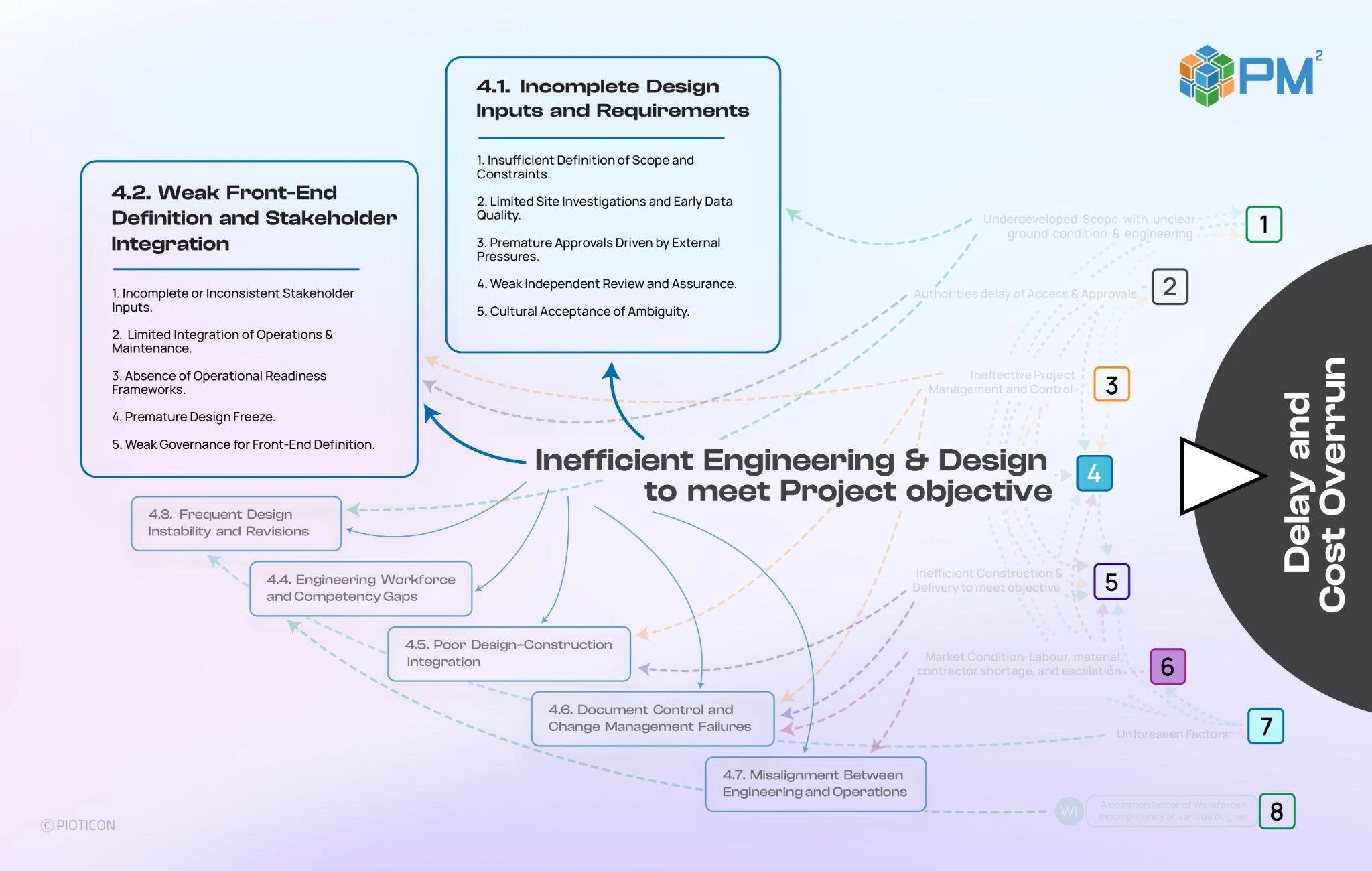
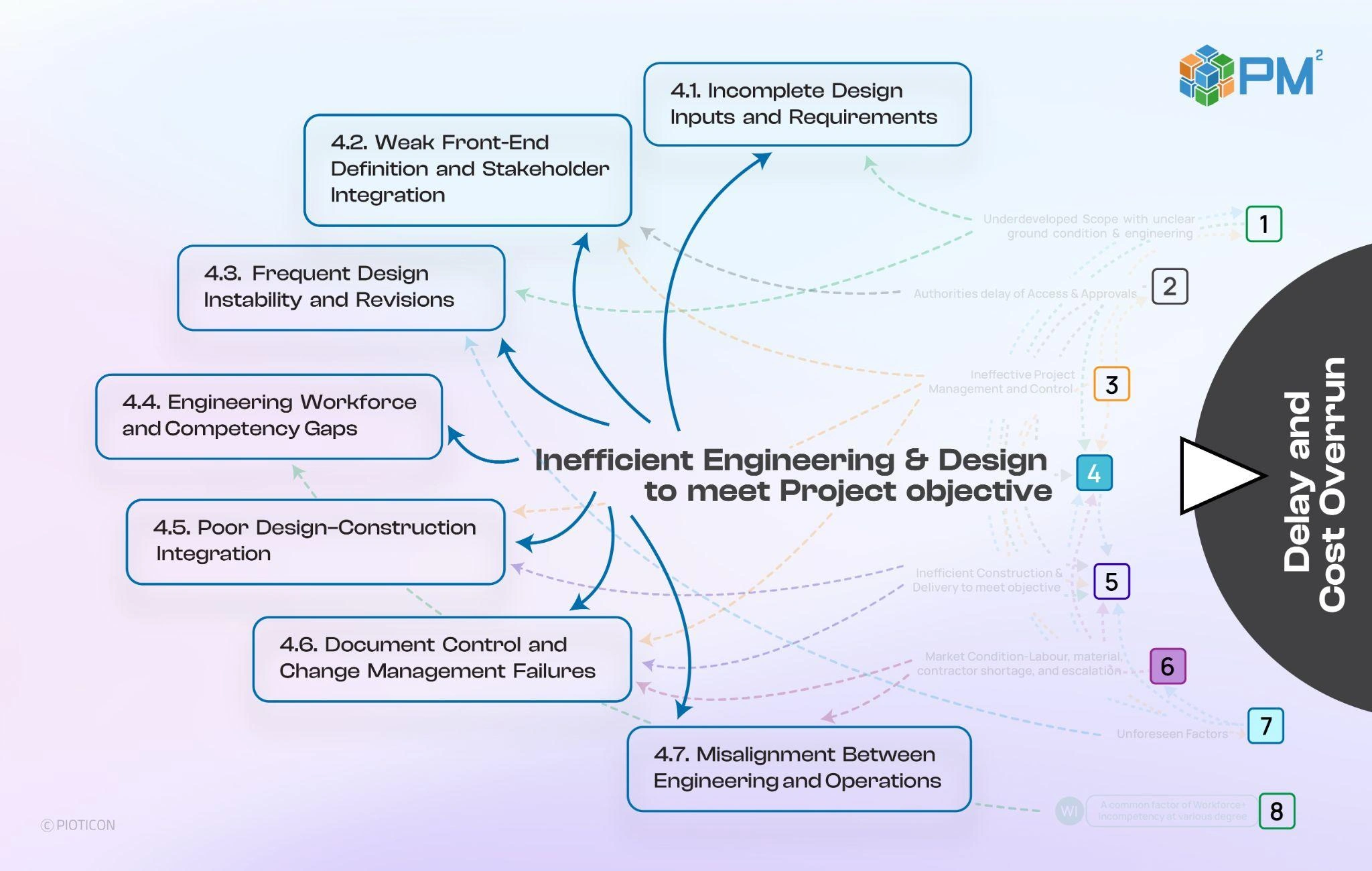
4.1. Incomplete Design Inputs and Requirements
The Problem
Design efforts frequently start without fully defined requirements. When project scope, constraints, and stakeholder needs are not clearly articulated at the outset, engineering teams work with partial information, forcing costly revisions later.
The Root Causes
1.1. Insufficient Definition of Scope and Constraints
- Early design begins without validated scope, constraints, or functional requirements
- Project teams rely on assumptions rather than verified inputs
- Ambiguity becomes embedded into the baseline and propagates errors downstream
1.2. Limited Site Investigations and Early Data Quality
- Restricted early budgets reduce the depth of geotechnical and survey data
- Critical subsurface and environmental inputs remain uncertain
- Missing data forces redesign later, increasing cost and time
1.3 Premature Approvals Driven by External Pressures
- Sponsors push for fast-track approvals to meet political or financial milestones
- Governance prioritizes milestone compliance over technical readiness
- Immature concepts advance into detailed design
1.4 Weak Independent Review and Assurance
- Scope inputs are not independently validated before design start
- Review mechanisms lack rigor or authority
- Incomplete requirements progress unchecked into design packages
1.5 Cultural Acceptance of Ambiguity
- Teams assume missing information can be resolved later
- Optimism bias leads to premature freezes and unrealistic baselines
- Ambiguity becomes normalized and drives repeated redesign
The Required Shift
- Institutionalize Front-End Loading (FEL) with readiness reviews
- Mandate independent scope and site validations before approval
- Redesign incentive structures to reward quality and completeness, not speed
4.2. Weak Front-End Definition and Stakeholder Integration
The Problem
The Root Causes
2.1 Incomplete or Inconsistent Stakeholder Inputs
- Stakeholder requirements are captured superficially
- Inputs from end users and regulators remain fragmented
- Misalignment grows as design advances
2.2 Limited Integration of Operations & Maintenance
- Operational needs are excluded from early design decisions
- Lifecycle considerations remain absent from technical criteria
- Resulting assets create high long-term O&M burden
2.3 Absence of Operational Readiness Frameworks
- No defined process aligns engineering with future operation scenarios
- Design teams lack structured criteria for operability
2.4 Premature Design Freeze
- Schedules drive premature locking of design without validation
- Later-stage changes become costly and disruptive
2.5 Weak Governance for Front-End Definition
- No accountability for ensuring completeness before progressing
- Governance bodies accept incomplete documentation
The Required Shift
- Conduct multi-stakeholder workshops to align requirements
- Integrate operational readiness scenarios into design reviews
- Enforce formal design-readiness gates tied to technical criteria, not schedule optics
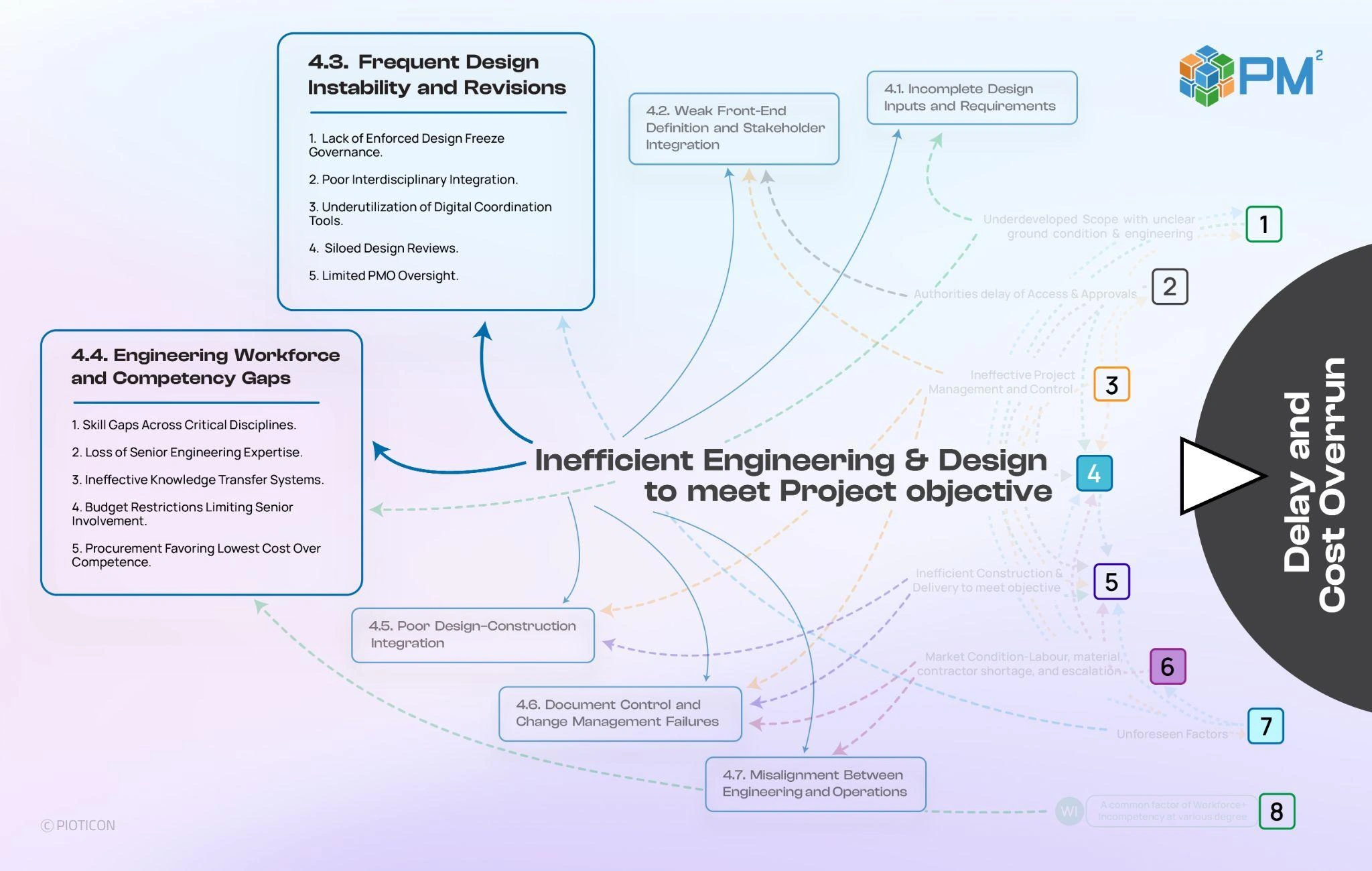
4.3. Frequent Design Instability and Revisions
The Problem
The Root Causes
3.1 Lack of Enforced Design Freeze Governance
- Design freeze milestones exist but are not respected
- Late changes disrupt engineering and construction sequences
3.2 Poor Interdisciplinary Integration
- Design conflicts are discovered late due to isolated discipline reviews
- Coordination mechanisms are weak or underutilized
3.3 Underutilization of Digital Coordination Tools
- BIM, 3D models, and clash detection are inconsistently applied
- Design maturity assessments lack digital support
3.4 Siloed Design Reviews
- Reviews occur discipline-by-discipline rather than integrated
- System-level issues remain undiscovered until construction
3.5 Limited PMO Oversight
PMOs lack authority to enforce integrated reviews or quality gates
The Required Shift
- Mandate digital interdisciplinary reviews using BIM and clash detection
- Empower PMOs with authority to enforce integrated reviews
- Require formal design freeze enforcement backed by governance accountability
4.4. Engineering Workforce and Competency Gaps
The Problem
The Root Causes
4.1 Skill Gaps Across Critical Disciplines
- Emerging technologies outpace current engineering capabilities
- Hard-to-fill roles undermine design robustness
4.2 Loss of Senior Engineering Expertise
- Retirements and turnover weaken mentorship and decision-making
- Institutional knowledge is not transferred effectively
4.3 Ineffective Knowledge Transfer Systems
- No structured mentorship or knowledge management platforms
- Tacit knowledge remains undocumented
4.4 Budget Restrictions Limiting Senior Involvement
- Cost pressures reduce participation of expert engineers
- Junior teams handle complex tasks without adequate guidance
4.5 Procurement Favoring Lowest Cost Over Competence
- Design contracts prioritize low pricing instead of expertise
- Technical capability assessments remain weak or absent
The Required Shift
- Establish engineering competency standards with certification requirements
- Fund structured mentorship and knowledge transfer programs
- Reform procurement to prioritize quality and expertise over lowest bids
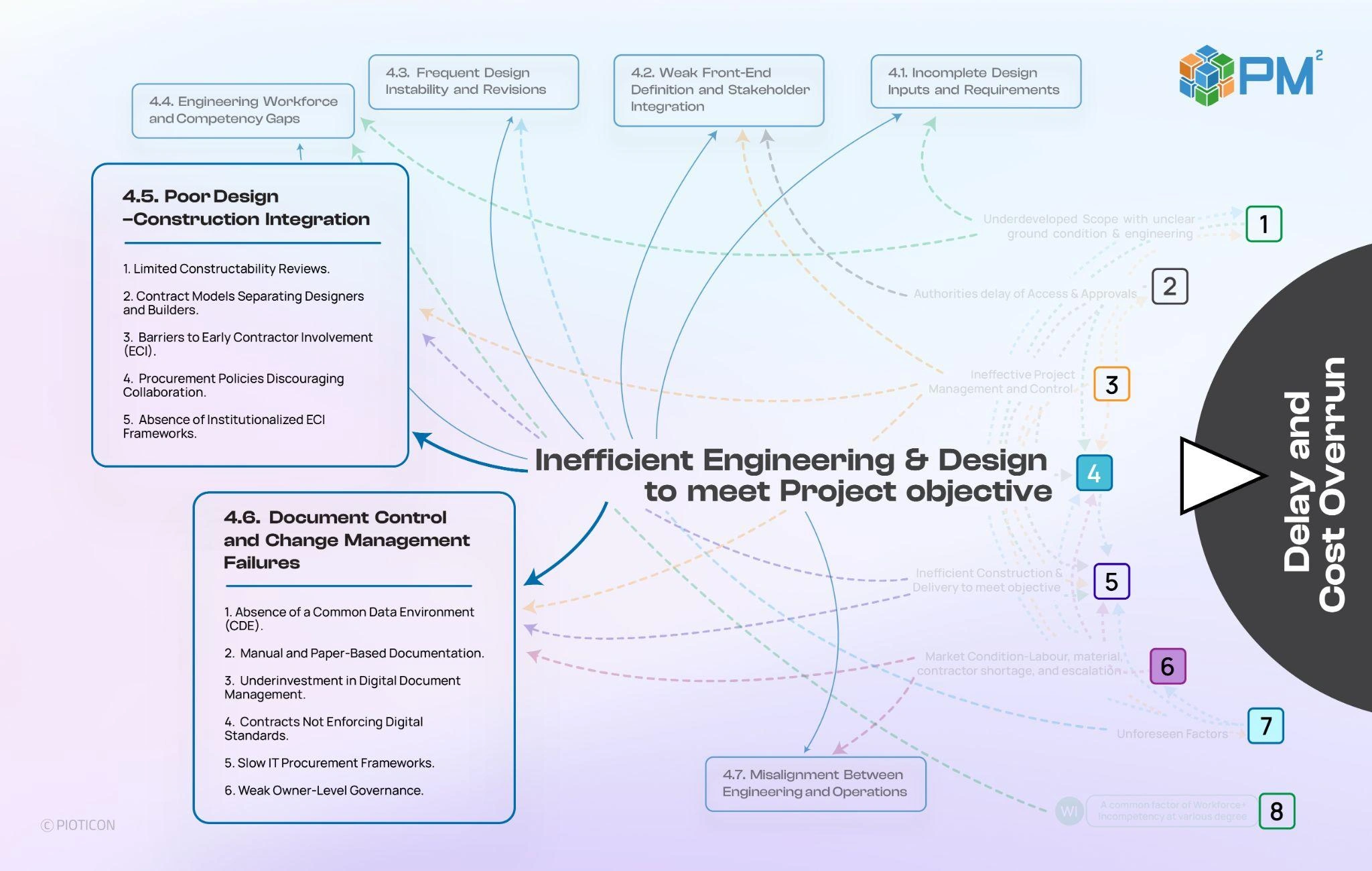
4.5. Poor Design - Construction Integration
The Problem
The Root Causes
5.1 Limited Constructability Reviews
- Reviews are superficial or conducted late in the design cycle
- Temporary works and sequencing constraints are overlooked
5.2 Contract Models Separating Designers and Builders
- Traditional Design–Bid–Build limits collaboration
- Designers lack early access to construction feedback
5.3 Barriers to Early Contractor Involvement (ECI)
- Commercial and legal frameworks do not support ECI
- Contractors cannot influence buildability during design
5.4 Procurement Policies Discouraging Collaboration
- Rigid tendering processes limit dialogue between design and construction
- Value engineering becomes reactive, not proactive
5.5 Absence of Institutionalized ECI Frameworks
- No standardized approach for early construction input
- Engineering progresses without field insights
The Required Shift
- Introduce structured Early Contractor Involvement frameworks
- Reform procurement policies to incentivize collaboration while maintaining transparency
- Mandate constructability reviews as part of design milestones
4.6. Document Control and Change Management Failures
The Problem
The Root Causes
6.1 Absence of a Common Data Environment (CDE)
- Engineering teams rely on separate systems and manual workflows
- Version control errors propagate rework
6.2 Manual and Paper-Based Documentation
- Slow, error-prone systems delay information flow
6.3 Underinvestment in Digital Document Management
- Organizations deprioritize modern platforms and tools
6.4 Contracts Not Enforcing Digital Standards
- Documentation requirements are not embedded contractually
6.5 Slow IT Procurement Frameworks
- Digital upgrades cannot be implemented at project pace
6.6 Weak Owner-Level Governance
- No enforcement of compliance with digital protocols
The Required Shift
- Mandate cloud-based, real-time document control systems
- Require all participants to operate through a common data environment
- Build contractual clauses to enforce digital compliance
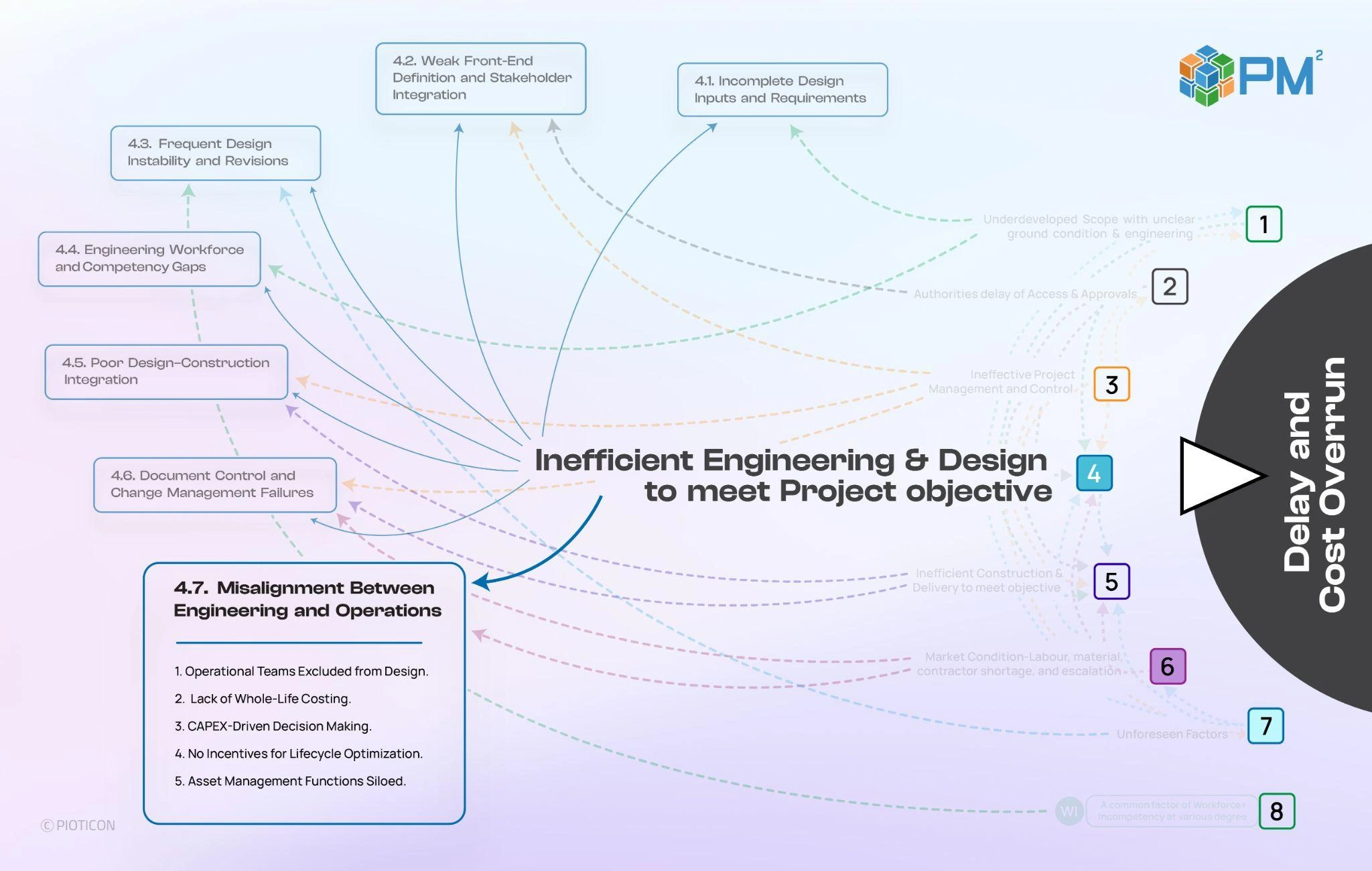
4.7. Misalignment Between Engineering and Operations
The Problem
The Root Causes
7.1 Operational Teams Excluded from Design
- Critical O&M needs are not reflected in design decisions
7.2 Lack of Whole-Life Costing
- OPEX implications are not analyzed during design selection
7.3 CAPEX-Driven Decision Making
- Short-term capital budgets override lifecycle performance
7.4 No Incentives for Lifecycle Optimization
- Teams are not rewarded for reducing long-term operating cost
7.5 Asset Management Functions Siloed
- No integration between asset managers and engineering leads
The Required Shift
- Integrate operational readiness teams into design reviews
- Apply whole-life costing models during design selection
- Incentivize project teams to optimize total lifecycle performance
Integrated Solutions Over Isolated Fixes
- Scope & Change Management
Incomplete or shifting scope destabilizes design; unstable design triggers uncontrolled scope changes. - Planning & Scheduling
Schedules collapse when design maturity is misaligned with construction sequencing and logic ties. - Estimating & Cost Management
Inaccurate design inputs distort cost estimates, contingencies, and forecasts. - Risk Management
Engineering assumptions become risk drivers that must feed directly into risk models and exposure buffers. - Performance Reporting
Reporting must reflect actual design maturity—not misleading “green” progress KPIs. - Fragmented Project Controls
Engineering must feed cost, schedule, and risk systems; otherwise controls remain disconnected. - PMC Governance
Governance must enforce design readiness standards and hold oversight teams accountable.
Sub-Clusters | Integrated Solution Focus |
Scope & Change Management | Anchor engineering through validated scope inputs and aligned change governance |
Planning & Scheduling | Integrate design maturity into logic sequencing, milestones, and construction readiness |
Estimating & Cost Management | Tie estimates to evolving design maturity with continuous updates and benchmarked data |
Risk Management | Embed design assumptions into quantitative risk models and contingency structures |
Performance Reporting | Align reporting with real design readiness, not calendar-driven progress |
Fragmented Project Controls | Link engineering data into cost, schedule, and risk systems to remove silos |
PMC Governance | Enforce design gate governance and hold teams accountable for readiness |
PMC Competency | Build multi-disciplinary design leadership with delivery, systems, and technical depth |
Beyond Engineering: How Other Clusters Affect Design
PMC is not an isolated function. Its effectiveness depends on the stability of the other seven PM² clusters:
- If Scope shifts, design becomes unstable.
- If Access & Approvals delay, design revisions pile up to match new conditions.
- If Market Conditions shift (material price, supply chain delays), design must be reworked for feasibility.
- If Construction is inefficient, design becomes reactive, creating churn.
- If Governance is weak, design gates become meaningless.
- If Risk is not integrated, engineering assumptions go unvalidated.
- If Workforce Competency is low, design quality degrades and errors multiply.
Engineering both absorbs these shocks and amplifies them when weak.
Conclusion: Integration is the Only Real Strategy
Engineering inefficiency is a systemic failure.
- Scope
- Planning
- Risk
- Constructability
- Governance
- Workforce competency