
- 23 October 2025
- Madan G Anand
- 0
The Real Cost of Ineffective Project Management and Control: A Root Cause Analysis
Project delays and cost overruns rarely happen overnight. They build up slowly through a thousand small misalignments, rushed decisions, and siloed systems. Despite modern tools and frameworks, large infrastructure projects continue to suffer from poor delivery outcomes.
This is not due to lack of effort, but lack of integration and effective system.
Success requires more than fixing one flaw at a time. Addressing just risk without looking at scope, or cost without factoring in planning, will only move the problem around. A truly effective project management approach demands interconnected solutions across all control dimensions.
This blog applies a root cause lens across seven core domains, such as, Scope, Planning, Cost, Risk, Reporting, Controls, and PMC Governance, to reveal where breakdowns happen and what integrated shifts are required to deliver lasting change.
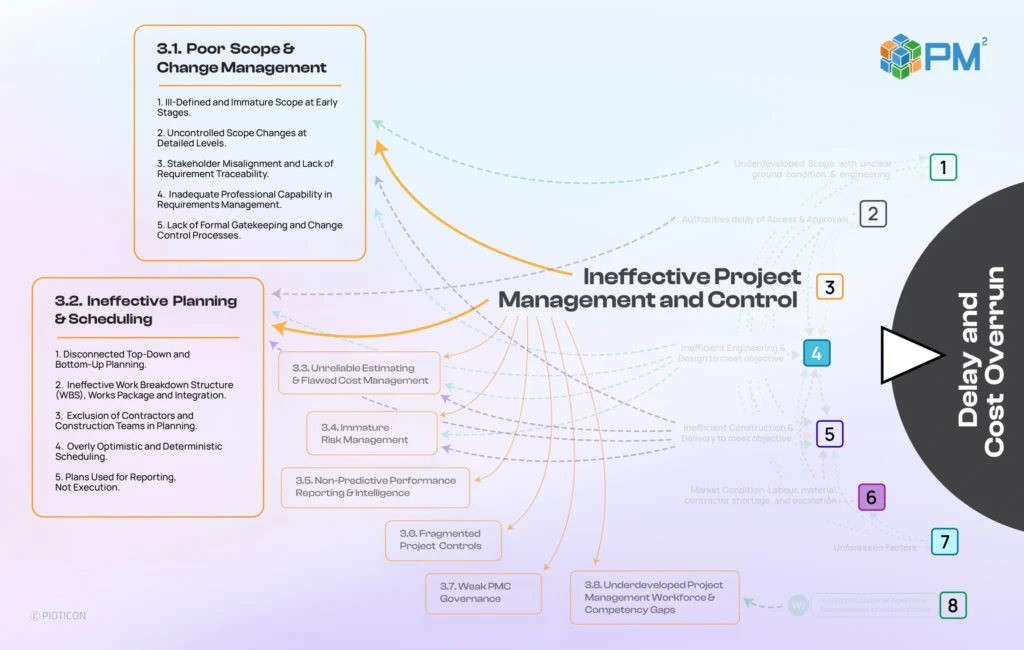
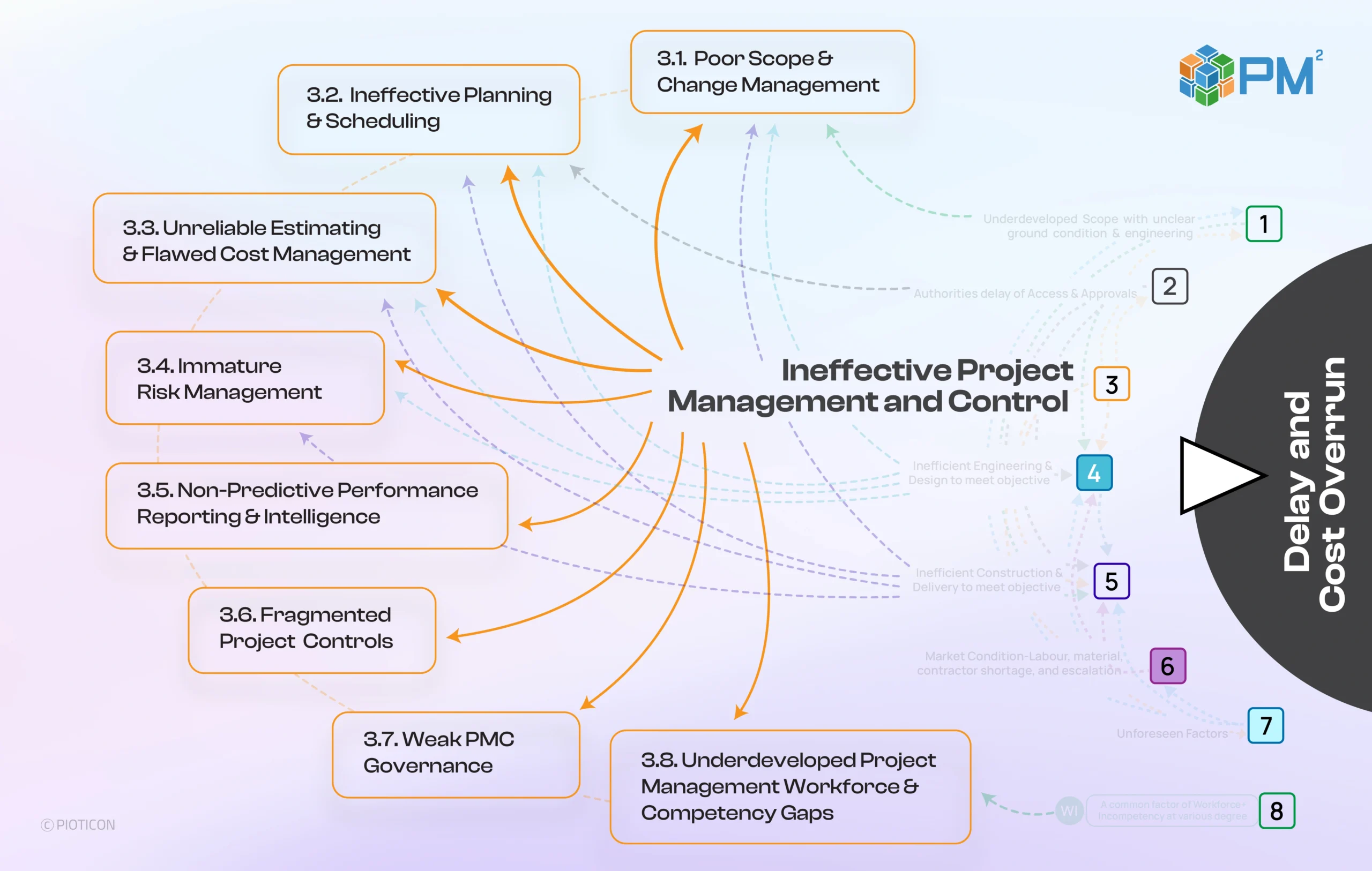
3.1. Poor Scope & Change Management
The Problem
Projects falter early when scope is ill-defined, stakeholders misaligned, and changes flow without analysis. Uncontrolled scope changes result in significant deviations from original baselines, creating cascading effects on cost, schedule, and quality.
The Root Causes
1.1 Ill-Defined and Immature Scope at Early Stages
- Poorly defined scopes, lacking the detail necessary to anchor planning and execution
1.2 Uncontrolled Scope Changes at Detailed Levels
- Scope changes occur primarily at detailed levels below Level 2. For instance, while a bridge’s overall length rarely changes, specific scope items and quantum and elements like concrete quantities, machinery hours, or labor requirements often change significantly. The impact of these detailed changes is frequently overlooked
- Changes are processed without fully analyzing their cost and schedule impacts
- Insufficient technical competency among Design Engineers, Construction Engineers, and Quantity Surveyors to accurately estimate quantities during both design and execution stages
1.3 Stakeholder Misalignment and Lack of Requirement Traceability
- Misaligned expectations between sponsors, end-users, and regulators generate conflicting priorities
- Limited stakeholder workshops and absence of requirement traceability tools weaken the quality of scope documentation
1.4 Inadequate Professional Capability in Requirements Management
- Teams often lack professionals skilled in eliciting and documenting requirements effectively
- Early optimism, often politically motivated, overrides technical assessments
1.5 Lack of Formal Gatekeeping and Change Control Processes
- The absence of formal gatekeeping processes during concept development allows immature scope definitions to proceed unchecked
The Required Shift
- Implement an Integrated and Advanced Work Package delivery model
- Formalize Front-End Loading (FEL) to delay scope freeze until readiness
- Conduct structured scope alignment workshops at concept stage
- Institutionalize change control boards that include cost and schedule analysts
- Coach and Develop professionals to build capability and competency in scope and change management at all levels from board to ground.
3.2. Ineffective Planning & Scheduling
The Problem
Plans often look good on paper but collapse on the field. Projects frequently suffer from schedule slippage, often missing key milestones and ultimately delaying completion.
The Root Causes
2.1 Disconnected Top-Down and Bottom-Up Planning
- Planning is often conducted in isolation without striking an appropriate balance between top-down strategic direction and bottom-up implementation insights.
2.2 Ineffective Work Breakdown Structure (WBS), Works Package and Integration
- Continuous changes in scope items compromise optimal execution planning and lead to reduced productivity.
- Ineffective Work Breakdown Structure (WBS) development results in shallow and incomplete project plans that fail to integrate across scope, schedule, cost, and risk.
- Deliverable work packages are not well integrated with design, procurement, construction, and completion packages.
2.3 Exclusion of Contractors and Construction Teams in Planning
- Construction teams, vendors, and contractors are often excluded from the planning process.
- Poor coordination of cross-discipline and contractor dependencies weakens schedule realism.
- In many cases, schedules become overly biased toward construction team details, creating unnecessarily complex schedules that are difficult to manage effectively.
2.4 Overly Optimistic and Deterministic Scheduling
- Overly aggressive timelines set to appease stakeholders ignore execution realities.
- Projects typically operate with overly optimistic deterministic schedules.
- Probabilistic simulations with quality data of Monte Carlo analysis are rarely used to quantify schedule risk. Even when teams do implement these techniques, they often fail to deliver their intended benefits due to other functions factors.
- Planners often lack deep project-specific knowledge, resulting in either oversimplified schedules or overly complex, excessively detailed schedules.
2.5 Plans Used for Reporting, Not Execution
- Plans are treated as paper exercises for reporting rather than practical execution guides.
The Required Shift
- Develop a balanced approach that combines Management top-down and detail bottom-up schedules with input from all stakeholders
- Implement collaborative planning with effective engagement across Master Schedule to Last Planner System
- Train Planning and Scheduling professionals in advanced integrated planning and scheduling techniques and interface management
- Conduct probabilistic schedule risk assessments to develop realistic, risk-adjusted schedules
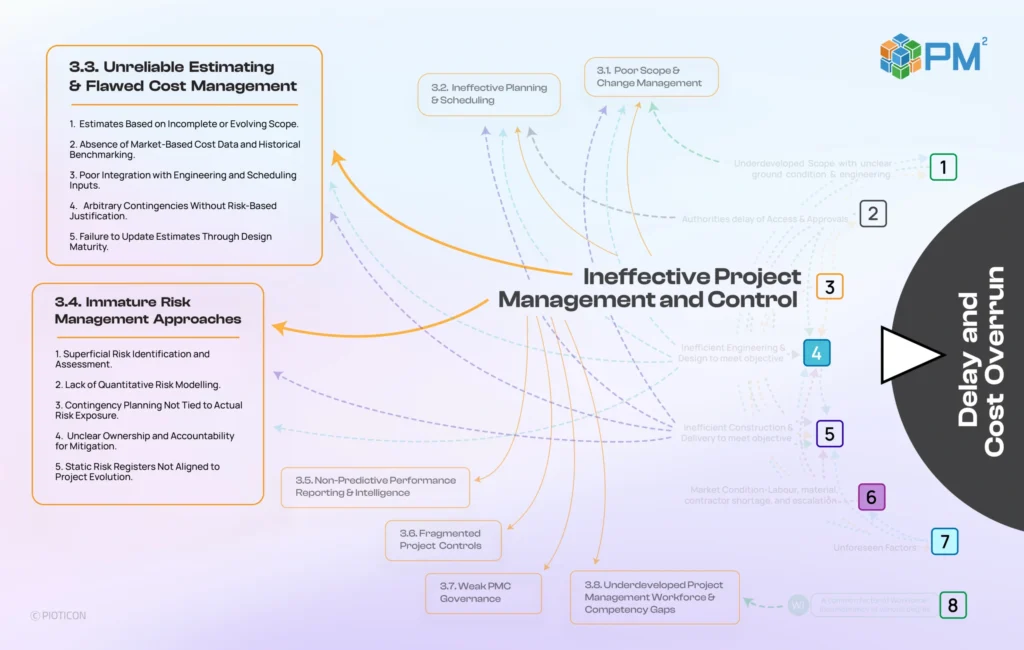
3.3. Unreliable Estimating & Flawed Cost Management
The Problem
The Root Causes
3.1 Estimates Based on Incomplete or Evolving Scope
- Changes in scope items disrupt optimal planning, consequently impacting estimation accuracy and cost control effectiveness
- Cost estimates and forecasts are built on incomplete or evolving scope definitions, methodology and schedule
- Insufficient design input at early stages leads to flawed cost assumptions
3.2 Absence of Market-Based Cost Data and Historical Benchmarking
- Estimates often lack grounding in current market-tested data
- Absence of cost databases and parametric models undermines estimate reliability
3.3 Poor Integration with Engineering and Scheduling Inputs
- Procurement terms may not align with estimating assumptions
- Cost estimates are not updated as design matures, leading to outdated financial baselines
3.4 Arbitrary Contingencies Without Risk-Based Justification
- Contingency budgets are often arbitrary, lacking structured risk analysis backing
3.5 Failure to Update Estimates Through Design Maturity
- Direct labor, machinery and material productivities, and proportionate indirect costs are not tracked effectively
The Required Shift
- Improve productivity through cost-effective design and planning, and implement tracking systems to monitor and prevent resource underutilization.
- Use structured cost estimation maturity models to stage-gate estimate development
- Align estimating activities with engineering progression gates
- Build and maintain institutional cost databases that capture historical and market data
3.4. Immature Risk Management Approaches
The Problem
Projects react rather than anticipate. Risks are recorded but rarely drive planning or decision-making.
The Root Causes
4.1 Superficial Risk Identification and Assessment
- Many projects start with superficial risk identification
- Limited participation across technical, legal, and external expert domains
4.2 Lack of Quantitative Risk Modelling
- Risks are not quantitatively modeled to accurately assess financial or schedule impacts
4.3 Contingency Planning Not Tied to Actual Risk Exposure
- Contingency allocations are not directly tied to quantified risk exposure
4.4 Unclear Ownership and Accountability for Mitigation
- Without clear accountability, mitigation actions fall through the cracks.
- Many PMOs and Project Management professionals lack staff skilled in quantitative risk analytics to establish an effective action and track to control risk
4.5 Static Risk Registers Not Aligned to Project Evolution
- Risk profiles are not dynamically updated as projects evolve
The Required Shift
- Institutionalize integrated quantitative risk management across all projects
- Formally assign risk ownership with clear accountability
- Link risk exposure directly to contingency setting for more resilient financial planning
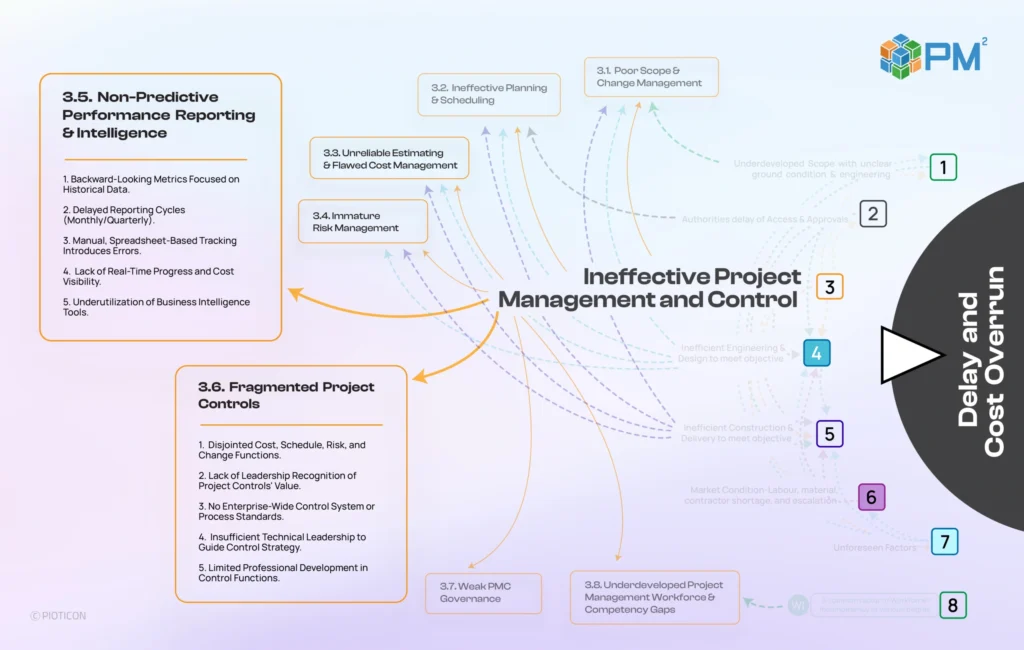
3.5. Non-Predictive Performance Reporting & Intelligence
The Problem
By the time bad news surfaces, it’s too late. Reporting is backward-looking and lacks predictive capability.
Reports provide only basic insights, lacking the forecasting and predictive capabilities necessary for effective decision making.
The Root Causes
5.1 Backward-Looking Metrics Focused on Historical Data
- Metrics often reflect past performance rather than forecasting future trends
- Early warning systems are rarely deployed.
5.2 Delayed Reporting Cycles (Monthly/Quarterly)
- Reliance on monthly or quarterly reporting cycles delays issue visibility
5.3 Manual, Spreadsheet-Based Tracking Introduces Errors
- Spreadsheet-based tracking introduces errors and slows data flow
5.4 Lack of Real-Time Progress and Cost Visibility
- Real-time data on progress, costs, and risks is often unavailable
- Fragmented project control software prevents holistic project visibility
5.5 Underutilization of Business Intelligence Tools
- Organisations / PMOs lack personnel trained in business intelligence (BI) tools
The Required Shift
- Implement integrated digital control systems for real-time data capture
- Deploy predictive analytics tools to identify emerging risks
- Train Project Management staff in effectively review performance reporting, business intelligence platforms and analytics
3.6. Fragmented Project Controls
The Problem
Project controls are commonly misunderstood, often confused with just as financial control, commercial management, or field operations controls – largely because these functions operate in isolation without Project Management capability.
The essential Project Management and Control functions – cost, schedule, risk, and change management – frequently operate without effective communication between them. This critical integrated function is either overlooked or deprioritized by leadership.
The Root Causes
6.1 Disjointed Cost, Schedule, Risk, and Change Functions
- Insufficient Project Management and Control competence for the specific project type and complexity
- Different disciplines use independent processes and systems
6.2 Lack of Leadership Recognition of Project Controls’ Value
- Organizational/Enterprise Leadership often overlooks Project Controls, viewing it as a cost rather than a value-adding function
- Controls are seen as administrative rather than strategic
- Control functions operate without sufficient influence
6.3 No Enterprise-Wide Control System or Process Standards
- No enterprise-wide project control system definitions exist
- Control processes are rarely evaluated systematically
6.4 Insufficient Technical Leadership to Guide Control Strategy
- Insufficient technical leadership to establish effective Integrated Project Controls.
- Lack of senior oversight prevents effective control system evolution
6.5 Limited Professional Development in Control Functions
- Limited professional development hinders control expertise
The Required Shift
- Implement an enterprise Integrated Project Controls(IPC) Framework
- Elevate the PMC function to have clear authority and accountability
- Build robust career pathways for project controls professionals
- Conduct regular controls maturity audits to drive continuous improvement
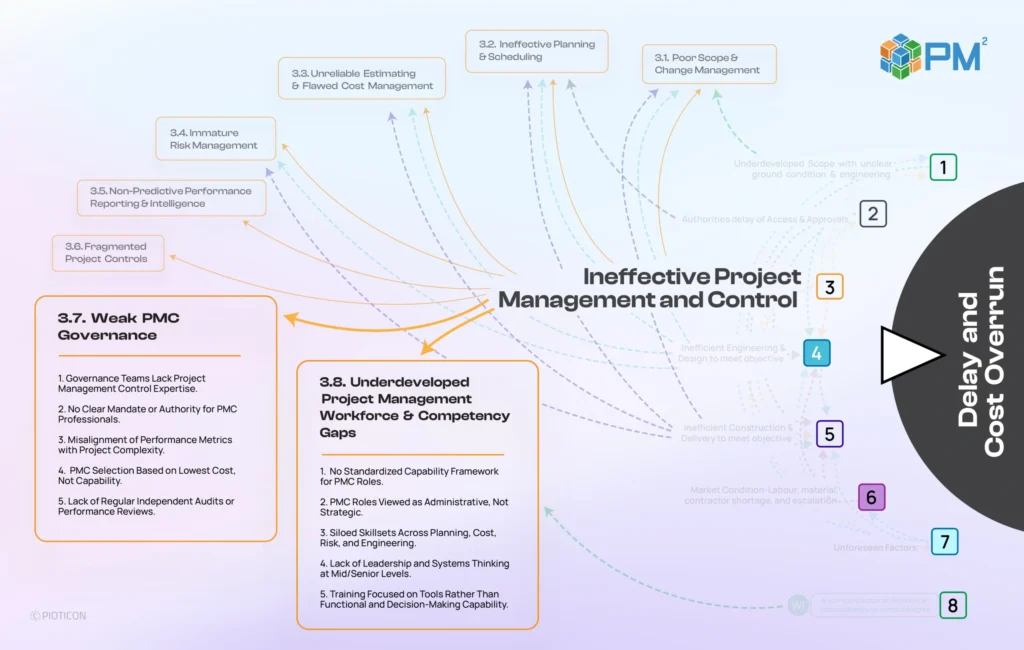
3.7. Weak PMC Governance
The Problem
Project Management Control Governance is often overly biased toward Engineering and Construction execution rather than appropriately balancing project performance to meet stakeholder objectives.
Project performance metrics for scope, schedule, cost, and risk are frequently misaligned and not set up for success relative to the specific complexity and type of project. Consequently, information flowing to governance bodies lacks meaningful insight for effective decision-making. These reports often serve merely as compliance exercises rather than tools for driving strategic performance management.
The Root Causes
7.1 Governance Teams Lack Project Management Control Expertise
- Governance bodies lack Project Management and Control subject matter expertise
- Leaders with titles but insufficient technical competence fail to provide proportionate technical leadership
- Decision makers rely on opinion-based views rather than quality data-driven insights
7.2 No Clear Mandate or Authority for PMC Professionals
- PMC professionals often lack clear mandates, operating under diluted authority
- Responsibility matrix are poorly defined, creating confusion
7.3 Misalignment of Performance Metrics with Project Complexity
- PMC effectiveness is rarely measured quantitatively
- Contracts typically lack outcome-based performance indicators that can be effectively monitored on a regular basis
7.4 PMC Selection Based on Lowest Cost, Not Capability
- PMC selection often prioritizes lowest cost over competency
- There is no formalized assessment of PMC capabilities
7.5 Lack of Regular Independent Audits or Performance Reviews
- Third-party audits of PMC performance are rare
The Required Shift
- Include Project Management Control expertise in the governance body.
- Define clear PMC competency standards and integrate them into selection criteria to enroll project management professionals team to deliver projects
- Implement PMC performance scorecards with quantitative KPIs to steer team with quality questions
- Conduct independent PMC audits to validate oversight effectiveness
3.8. Underdeveloped Project Management Workforce & Competency Gaps
The Problem
Large-scale infrastructure projects demand more than systems and tools, they need capable people at the core. Yet, across the board, there is a persistent mismatch between the complexity of projects and the competencies of professionals leading them.
PMC roles are often assigned without rigorous assessment of capability. As a result, critical functions like planning, cost control, and risk management are handled by professionals who may not be equipped for the task not due to lack of intent, but due to lack of structured pathways and standards.ween the complexity of projects and the competencies of professionals leading them.
The Root Causes
8.1 No Standardized Capability Framework for PMC Roles
- No standardised capability frameworks to guide hiring, development, or role allocation.
8.2 PMC Roles Viewed as Administrative, Not Strategic
- PMC careers are undervalued, often perceived as administrative rather than strategic.
8.3 Siloed Skillsets Across Planning, Cost, Risk, and Engineering
- Cross-functional understanding is missing, creating silos across planning, cost, risk, and engineering.
8.4 Lack of Leadership and Systems Thinking at Mid/Senior Levels
- Technical and leadership maturity is lacking, especially in mid and senior roles.
8.5 Training Focused on Tools Rather Than Functional and Decision-Making Capability
- Current training prioritises teaching technical tools and software rather than developing deeper functional understanding of project management principles
- There’s insufficient focus on building decision-making skills that allow PMC professionals to make strategic choices
- Tool-focused training creates professionals who know how to operate systems but may lack the judgment to interpret results effectively
The Required Shift
- Establish clear competency standards and career pathways for PMC roles across all project levels.
- Invest in structured training and development, beyond tool proficiency — focused on systems thinking and decision-making.
- Elevate the role of PMC functions, positioning them as equal to engineering and commercial leadership.
- Promote cross-disciplinary exposure to foster holistic understanding across delivery functions.
Integrated Solutions Over Isolated Fixes
Project delays and cost overruns rarely result from a single weak link. They accumulate when interdependent systems underperform without coordination. Isolated fixes may offer temporary relief, but without addressing the underlying connections across planning, controls, governance, and capability, problems resurface in new forms.
Each PMC sub-cluster both depends on and influences the others:
- Scope & Change Management sets the baseline, but unstable scope feeds directly into unreliable schedules, cost estimates, and risk buffers.
- Planning & Scheduling can only hold if scope is mature and risks are quantified; otherwise, timelines collapse and contractors disengage.
- Estimating & Cost Management relies on realistic planning and design progress, while inaccurate estimates distort governance and reporting.
- Risk Management must tie into cost and schedule buffers; left standalone, risks become a registry exercise without impact.
- Performance Reporting needs integrated inputs across scope, cost, and risk to provide foresight, not just backward-looking compliance.
- Project Controls and Governance must enforce integration across functions, while PMC Competency underpins every cluster with skilled people.
Beyond PMC, delays in Access & Approvals, frequent Scope Changes, or inefficiencies in Design & Construction all ripple into PMC processes. At the same time, weak PMC disciplines amplify failures across these clusters.
| Sub-Clusters | Integrated Solution Focus |
| Scope & Change Management | Anchor planning through mature scope and aligned change control |
| Planning & Scheduling | Institutionalize Link execution logic with risk exposure and interface inputs |
| Estimating & Cost Management | Develop living estimates that evolve with changes in scope and emerging risks |
| Risk Management | Tie risk outputs to schedule float and contingency buffers |
| Performance Reporting | Build intelligence systems that cut across cost, time, scope, and earned value |
| Fragmented Project Controls | Break silos and report cumulative impact across functions |
| PMC Governance | Hold oversight teams accountable to integrated performance, not just siloed metrics |
| PMC Competency | Build a capable workforce with aligned technical depth, delivery mindset, and leadership clarity |
In addition, PMC is not self-contained. Its effectiveness is shaped by the other seven clusters of project performance (as outlined in Pioticon’s holistic model). For example:
- When Scope keeps changing, baselines collapse and planning becomes unreliable.
- When Access & Approvals slip, schedules stall and workforce capability is undercut.
- When Design & Construction is inefficient, estimates and risk buffers lose validity.
PMC not only absorbs these shocks but also amplifies them if its own sub-clusters are weak. This makes integration across all eight clusters essential for sustainable project performance.
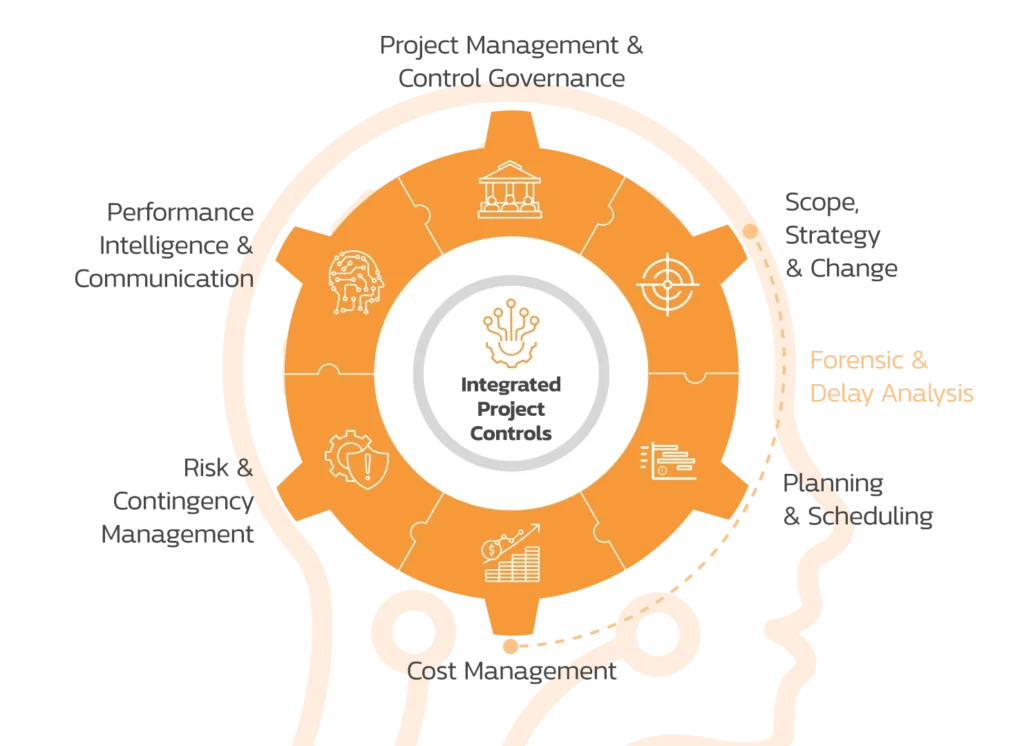
Conclusion: Integration Is the Only Real Strategy
Project failure is not born of individual errors. It emerges when systems are misaligned, decisions are made in silos, and functions operate without shared purpose.
Leaders must resist the temptation of isolated fixes. Addressing risk without controls, or scope without planning, guarantees only partial progress.
Sustainable improvement will come only when organizations commit to integration across capabilities, tools, teams, and timelines.
Project excellence is not a product of control in one area. It is a result of unified oversight, collaborative intelligence, and synchronized execution.