
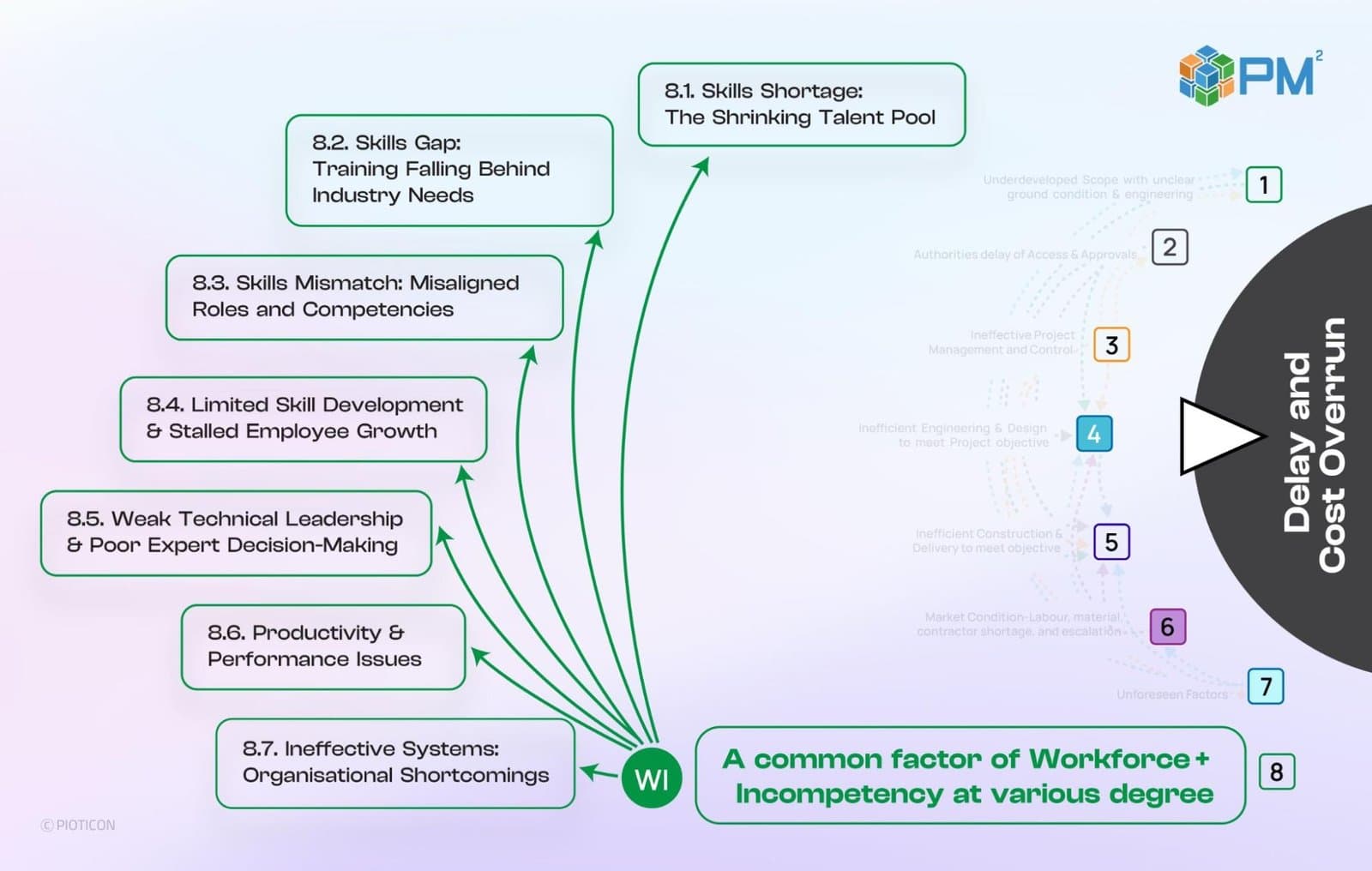
Skills Shortage to Systemic Failure: A Root Cause Analysis of Workforce Incompetency
Workforce competency is the backbone of any project or organization aiming to achieve consistent success. Yet across industries, a growing crisis threatens both productivity and project outcomes: workforce incompetency. Budgets are strained, schedules slip, quality suffers, and disputes multiply when teams lack the skills, leadership, and systems required to deliver.
This is not the result of individual underperformance alone. It reflects deeply rooted systemic failures across education, training, organizational practices, and governance. Using a root cause analysis framework, this article examines the capacity and capability issues fueling workforce incompetency and sets out why only integrated solutions can address the crisis effectively.
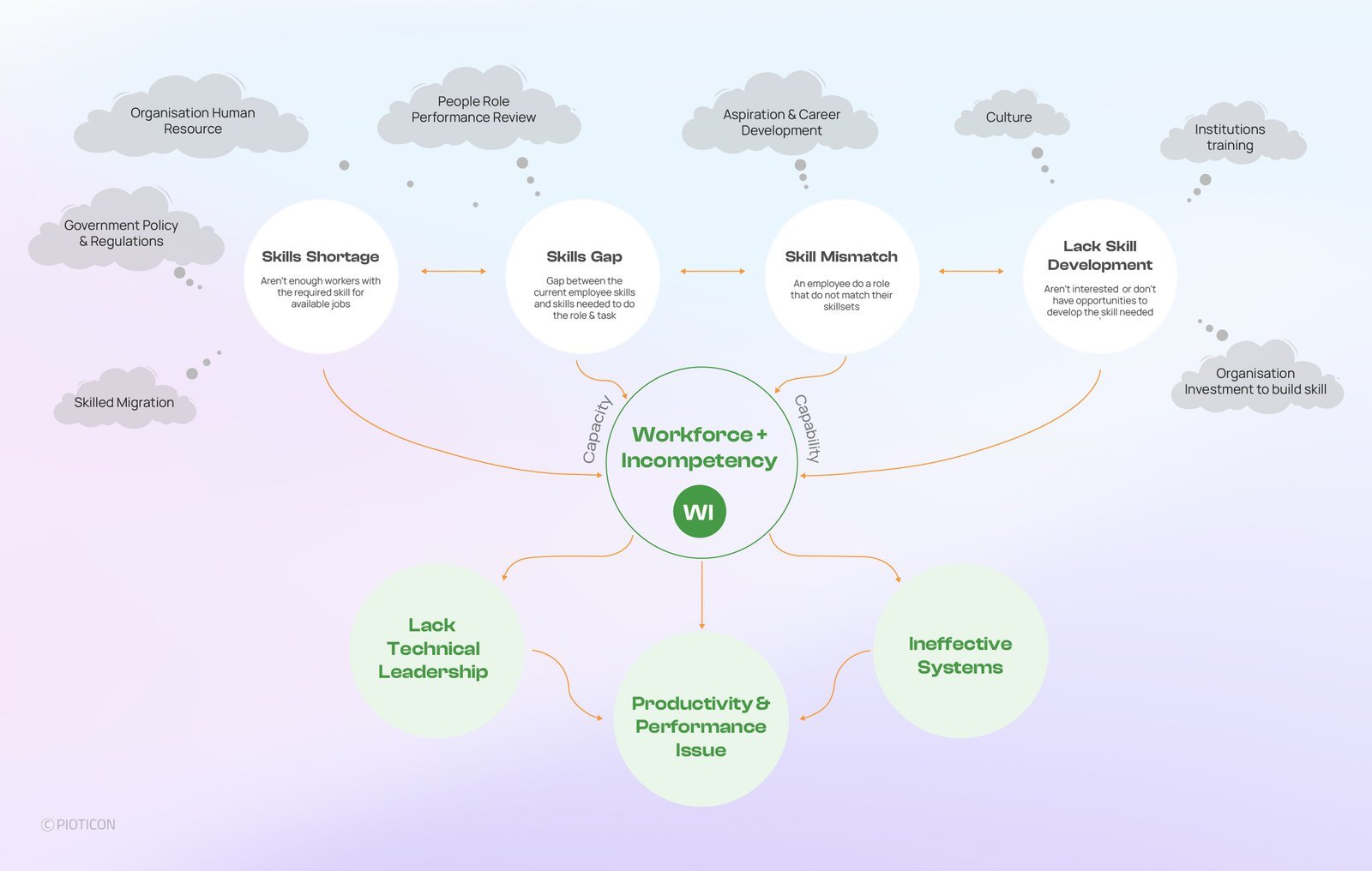
The Symptom: Delivery Undermined by Workforce Gaps
Even on projects with robust schedules, systems, and contracts, leaders repeatedly encounter:
- Chronic under-productivity and rework
- Supervisors and managers stretched beyond their competence
- High staff turnover and weak talent pipelines
- Training spend with little measurable impact
- Fragmented HR data that cannot support strategic decisions
These symptoms are visible at site and boardroom level. The causes sit deeper—within talent pipelines, training models, leadership pathways, and workforce systems.
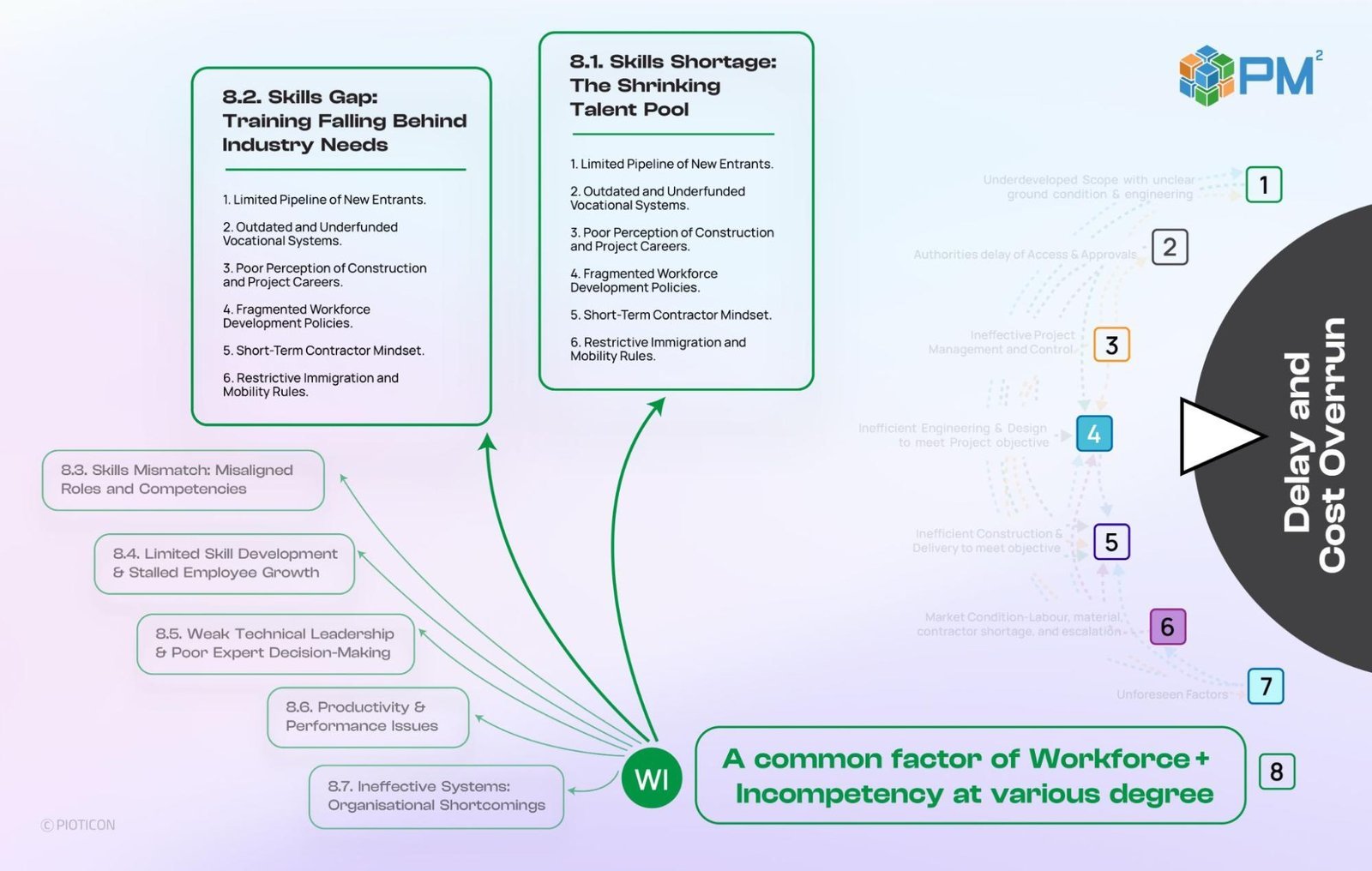
8.1. Skills Shortage: The Shrinking Talent Pool
The Problem
There are simply not enough suitably skilled people entering and staying in technical, supervisory, and project roles, creating chronic capacity gaps.
The Root Causes
1.1. Limited Pipeline of New Entrants
- Few young people choose vocational and technical careers; intakes into trades and technical programmes are declining
1.2. Outdated and Underfunded Vocational Systems
- Many institutes operate with dated curricula, limited equipment, and weak industry linkages
1.3. Poor Perception of Construction and Project Careers
- Work is viewed as physically demanding, unstable, and less prestigious than alternative sectors
1.4. Fragmented Workforce Development Policies
- No unified national strategy connects government, industry, and education providers
1.5. Short-Term Contractor Mindset
- Employers rely on temporary hiring rather than building long-term capability pipelines
1.6. Restrictive Immigration and Mobility Rules
- Skilled international labour is hard to attract or deploy where demand peaks
The Required Shift
- Launch national workforce-attraction programmes with strong public–private partnerships
- Fund modernised vocational and technical education with industry-aligned curricula
- Run career-branding campaigns repositioning construction and project delivery as skilled, technology-enabled professions
- Reform migration and mobility policies to support strategic inflows of skilled labour
8.2. Skills Gap: Training Falling Behind Industry Needs
The Problem
Even where people are available, their skills lag behind project and technology requirements.
The Root Causes
2.1. Training Content Not Keeping Pace with Technology
- Curricula and short courses fail to reflect digital tools, modern methods, and new regulations
2.2. Weak Industry–Academia Collaboration
- Limited structured input from employers into course design and assessment
2.3. Absence of National Skills Frameworks
- No consistent definition of competency levels across roles and sectors
2.4. Variable Quality of Training Providers
- Providers operate without rigorous accreditation or outcomes-based auditing
2.5. Minimal Employer Investment in Training
- Contractors often minimise training budgets to protect margins
2.6. Procurement Models Ignoring Training Obligations
- Bids are assessed on price rather than on commitments to workforce capability
The Required Shift
- Establish national skills frameworks and certification standards for key roles
- Mandate contractor contributions to structured training through procurement conditions
- Accredit and regularly audit training providers against outcome metrics
- Embed workforce competency KPIs into tender evaluation and contract performance reviews
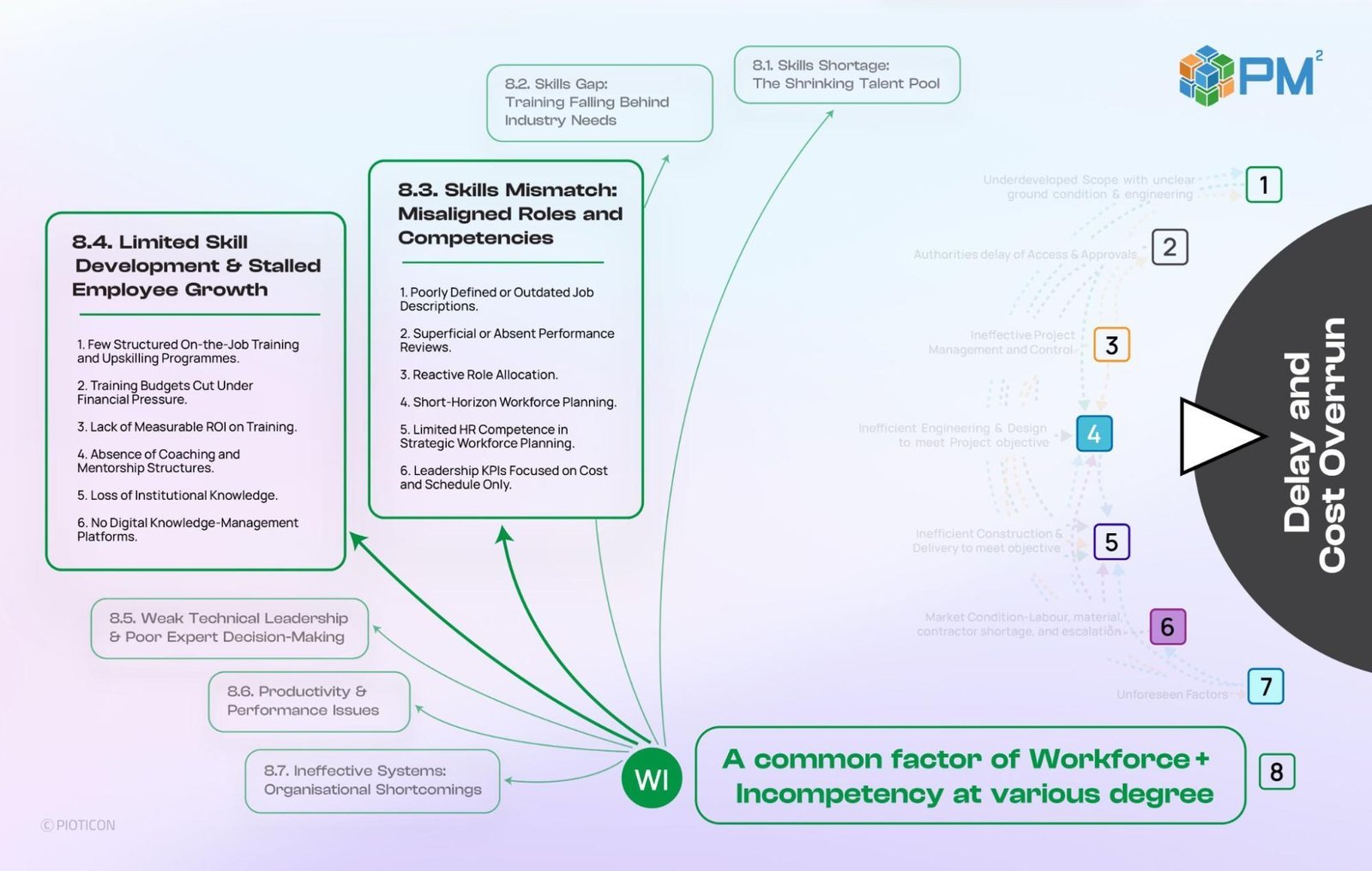
8.3. Skills Mismatch: Misaligned Roles and Competencies
The Problem
People are often placed in roles that do not match their skills, experience, or behaviour profile, leading to weak decisions and inconsistent performance.
The Root Causes
3.1. Poorly Defined or Outdated Job Descriptions
- Role expectations do not reflect contemporary project demands or complexity
3.2. Superficial or Absent Performance Reviews
- Feedback systems fail to diagnose competency gaps or development needs
3.3. Reactive Role Allocation
- Supervisors fill positions urgently rather than assessing long-term fit
3.4. Short-Horizon Workforce Planning
- Planning focuses on current vacancies, not future capability requirements
3.5. Limited HR Competence in Strategic Workforce Planning
- HR functions operate transactionally rather than as talent strategists
3.6. Leadership KPIs Focused on Cost and Schedule Only
- Managers are rarely measured on team development or successio
The Required Shift
- Institutionalise structured workforce planning at enterprise and project level
- Create clear career pathways with competency requirements by level
- Align leadership KPIs with talent development and succession planning
- Require owners and sponsors to mandate workforce development reporting for major projects
8.4. Limited Skill Development & Stalled Employee Growth
The Problem
Once hired, many employees do not receive structured development, leading to stagnant skills and repeated mistakes.
The Root Causes
4.1. Few Structured On-the-Job Training and Upskilling Programmes
- Learning is ad hoc and driven by immediate needs
4.2. Training Budgets Cut Under Financial Pressure
- Capability investment is treated as discretionary rather than strategic
4.3. Lack of Measurable ROI on Training
- Organisations rarely track performance or productivity improvements from learning
4.4. Absence of Coaching and Mentorship Structures
- Senior staff are not formally tasked or rewarded for developing others
4.5. Loss of Institutional Knowledge
- Retirements and resignations drain tacit knowledge that is not documented
4.6. No Digital Knowledge-Management Platforms
- Lessons learned, standards, and playbooks are not centrally captured or searchable
The Required Shift
- Build formal mentorship and coaching systems with clear expectations
- Create digital repositories for procedures, lessons learned, and best practices
- Mandate continuous on-the-job training programmes aligned with role competencies
- Track and report training ROI using productivity, quality, and safety indicators
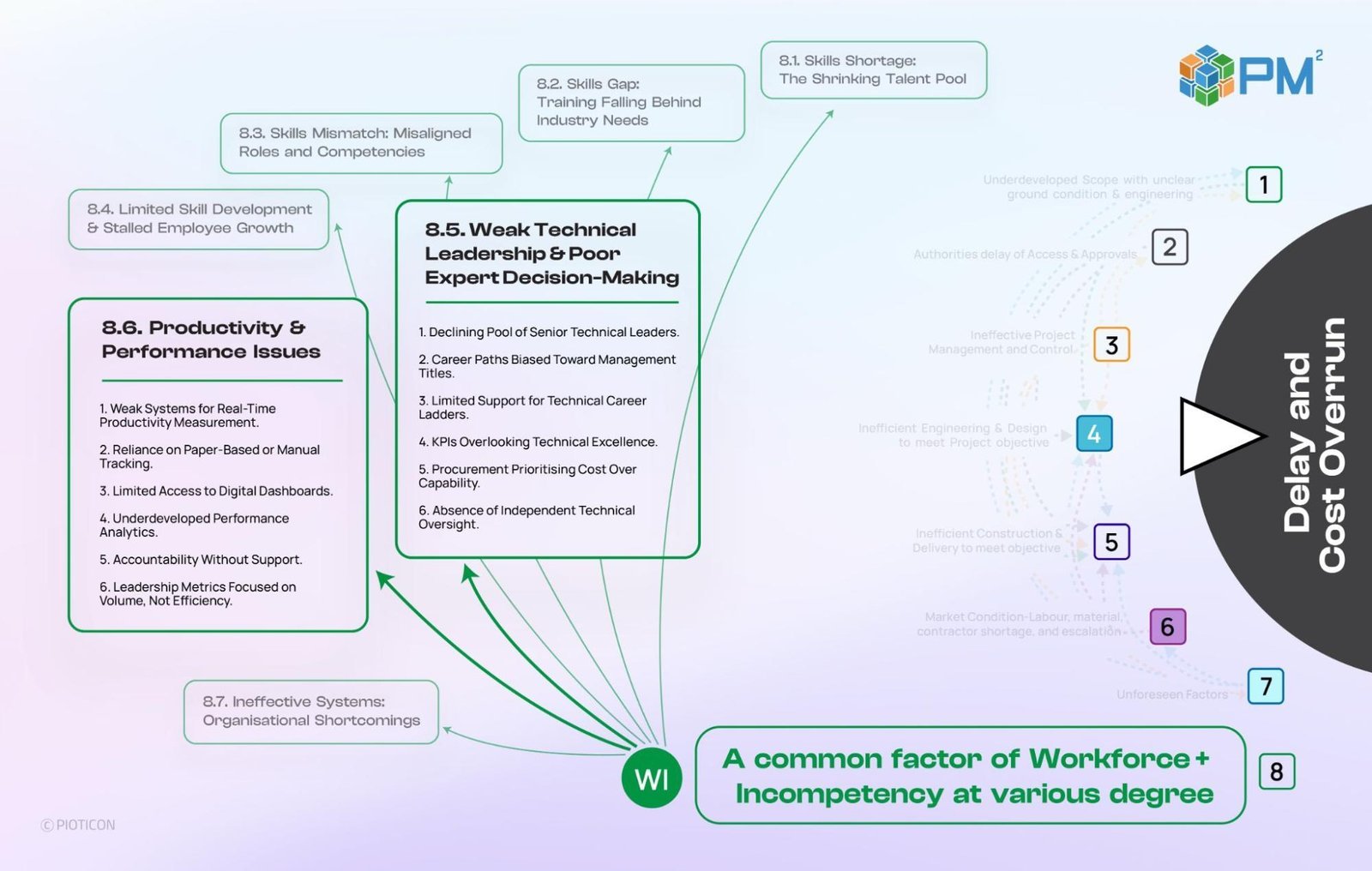
8.5. Weak Technical Leadership & Poor Expert Decision-Making
The Problem
Projects lack strong technical leaders who can make proportionate, evidence-based decisions and guide complex trade-offs.
The Root Causes
5.1. Declining Pool of Senior Technical Leaders
- Experienced experts retire or exit the industry without replacement
5.2. Career Paths Biased Toward Management Titles
- Advancement is often only possible by leaving technical work
5.3. Limited Support for Technical Career Ladders
- HR systems do not recognise or reward technical mastery
5.4. KPIs Overlooking Technical Excellence
- Leadership evaluation rarely includes quality of technical decisions
5.5. Procurement Prioritising Cost Over Capability
- Selection of consultants and contractors downplays technical governance roles
5.6. Absence of Independent Technical Oversight
- Few organisations use independent panels or audits to challenge critical decisions
The Required Shift
- Create dual technical and managerial career tracks with equal status
- Introduce technical governance panels to oversee critical decisions and standards
- Recognise technical leadership KPIs in performance evaluations and rewards
- Commission external audits of technical leadership and decision quality on major programmes
8.6. Productivity & Performance Issues
The Problem
Even with adequate headcount, productivity and performance remain below expectations, undermining cost and schedule outcomes.
The Root Causes
6.1. Weak Systems for Real-Time Productivity Measurement
- Data on output, downtime, and constraints is late or unreliable
6.2. Reliance on Paper-Based or Manual Tracking
- Field information is fragmented and slow to consolidate
6.3. Limited Access to Digital Dashboards
- Supervisors cannot view or act on performance data in the field
6.4. Underdeveloped Performance Analytics
- Data is collected but not converted into insight or coaching actions
6.5. Accountability Without Support
- Workers are judged on outcomes but receive limited feedback or coaching
6.6. Leadership Metrics Focused on Volume, Not Efficiency
- Leaders chase output numbers without understanding underlying productivity drivers
The Required Shift
- Deploy real-time digital field data capture for productivity and performance
- Provide supervisors with mobile dashboards and coaching tools
- Institutionalise performance analytics platforms that feed into review routines
- Train supervisors as performance coaches, not just compliance enforcers
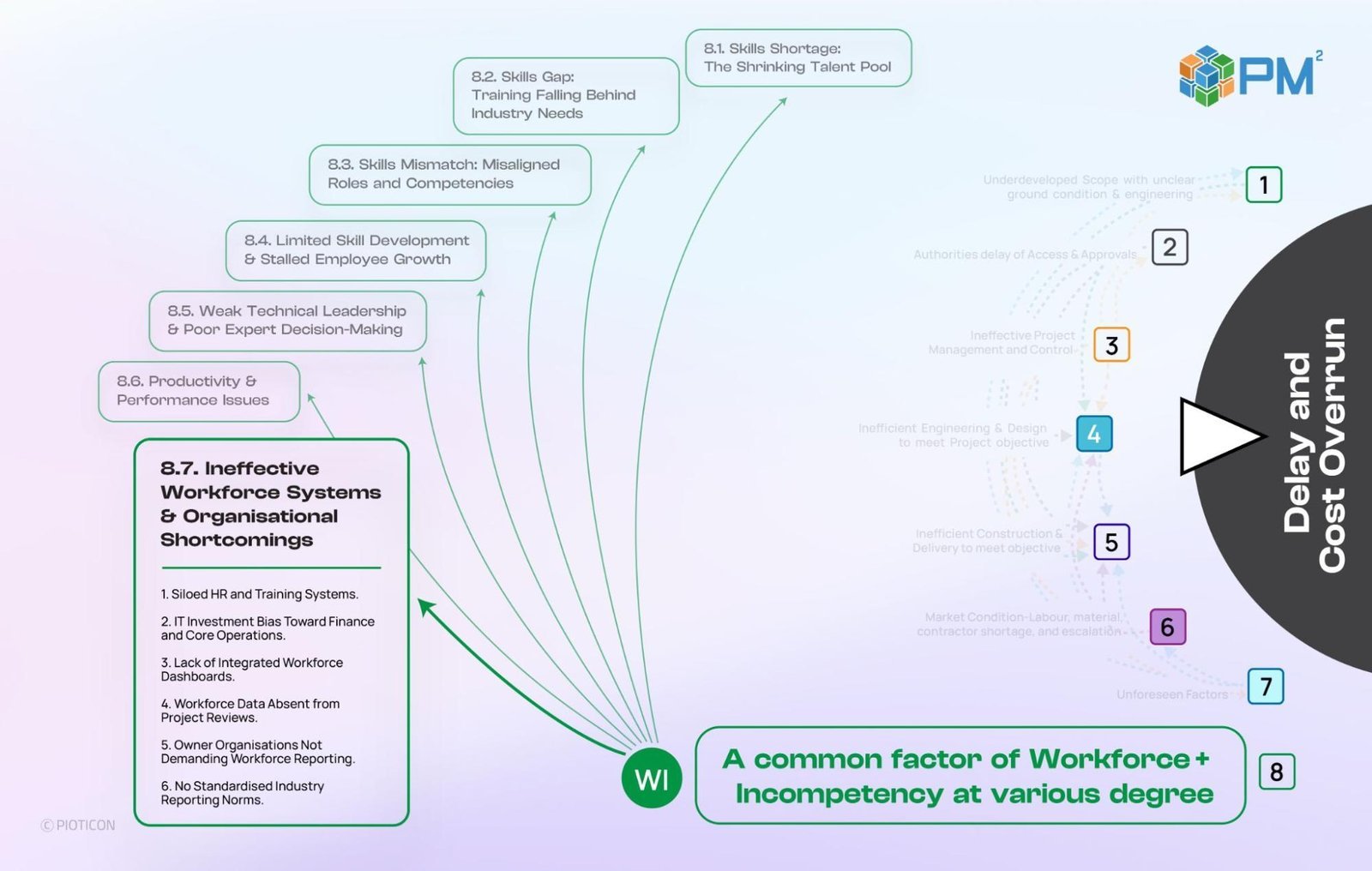
8.7. Ineffective Workforce Systems & Organisational Shortcomings
The Problem
Legacy HR and workforce systems cannot provide the integrated intelligence needed to steer capability at enterprise or project level.
The Root Causes
7.1. Siloed HR and Training Systems
- Recruitment, learning, and performance data are fragmented across platforms
7.2. IT Investment Bias Toward Finance and Core Operations
- Workforce platforms receive lower priority in digital roadmaps
7.3. Lack of Integrated Workforce Dashboards
- Leaders lack consolidated views of skills, training, attrition, and performance
7.4. Workforce Data Absent from Project Reviews
- Steering committees focus on cost and schedule without capability insights
7.5. Owner Organisations Not Demanding Workforce Reporting
- Contracts and governance frameworks rarely require structured competency data
7.6. No Standardised Industry Reporting Norms
- Benchmarking across projects and organisations is limited or inconsistent
The Required Shift
- Develop integrated workforce-intelligence platforms linking HR, training, and performance
- Provide enterprise dashboards covering skills, development, mobility, and risk
- Require workforce competency reporting within project charters and governance packs
- Create industry benchmarks and standards for workforce metrics and disclosure
Integrated Solutions Over Isolated Fixes
Workforce incompetency is never caused by a single weakness. It is the combined effect of shortages, skills gaps, role mismatches, weak leadership, stalled development, and fragmented systems. Fixing only one element, such as launching a training programme without revisiting career paths or data systems, leaves the overall structure fragile.
Each workforce sub-cluster both depends on and reinforces the others:
- A strong talent pipeline is wasted if training content is outdated
- High-quality training fails if roles and competencies are misaligned
- Capable individuals underperform without technical leadership and coaching
- Performance cannot be steered without real-time analytics and integrated systems
| Sub-Cluster | Integrated Solution Focus |
|---|---|
| Talent Pipeline & Attraction | Build national and sector-level strategies to attract and retain skilled entrants into project and technical careers. |
| Skills & Training Alignment | Define national skills frameworks and align accredited training to real project and technology needs. |
| Role–Competency Fit & Deployment | Use structured workforce planning and competency-based role design for every level of the organisation. |
| Continuous Development & Knowledge Transfer | Institutionalise mentorship, on-the-job learning, and digital knowledge repositories to retain and grow expertise. |
| Technical Leadership & Governance | Establish dual technical/managerial career tracks and independent technical oversight for major decisions. |
| Productivity & Performance Intelligence | Combine field data, analytics, and coaching practices to translate competence into measurable output. |
| Workforce Systems & Analytics | Integrate HR, training, and performance platforms into enterprise workforce-intelligence dashboards. |
| Owner & Policy Governance Alignment | Embed workforce competency expectations and reporting into contracts, regulations, and programme governance. |
In addition, Workforce & Competency is tightly interlinked with the other seven PM² clusters:
- When Scope, Planning, and Risk are complex but workforce capability is weak, even well-designed systems fail in execution.
- When Market Conditions and Unforeseen Events shift, only organisations with strong workforce mobility and learning systems adapt effectively.
- When PMC Governance and Controls ignore capability data, decisions are made on numbers, not on whether teams can actually deliver.
Workforce incompetency does not just reflect systemic weakness—it amplifies it across every other cluster.
Conclusion: From Fragmented Effort to Integrated Capability
Workforce incompetency is not a surface-level issue. It is the visible outcome of fragmented policies, outdated systems, underspecified roles, and short-term thinking. Organisations that pursue piecemeal fixes, one training course here, one recruitment drive there, will continue to see declining productivity and escalating costs.
Sustainable improvement demands integrated solutions that link talent pipelines, skills frameworks, leadership pathways, digital systems, and governance into a single coherent approach.
With committed leadership and coordinated execution, industries can rebuild a competent, agile, and high-performing workforce, one capable of meeting the demands of modern infrastructure and complex project delivery.