
Breaking the Cycle of Delays and Overruns: A Root Cause Analysis of Construction & Delivery Inefficiency
Construction sits at the heart of national growth and infrastructure development. Yet too many projects still struggle to deliver on their promises. Cost overruns, missed deadlines, quality compromises, safety incidents, and contractual disputes continue to erode trust in project outcomes.
Despite the adoption of modern tools and frameworks, inefficiency in construction and delivery remains a persistent and costly challenge.
Root Cause Analysis (RCA) provides a structured lens to go beyond visible symptoms and uncover the deeper systemic issues driving these failures. This blog examines those causes across key areas of construction delivery and explains why only integrated, system-wide solutions can break the cycle of delays and overruns.
The Symptom: Delivery Breakdown on the Field
Despite detailed schedules and experienced teams, project sites repeatedly face:
- Missed milestone dates
- Rising costs and resequencing
- High frequency of rework and NCRs
- Safety or Environmental incidents causing shutdowns
- Disputes between contractors, subcontractors, and owners
These symptoms point to deeper structural issues in sequencing, constructability, readiness, and governance across construction delivery.
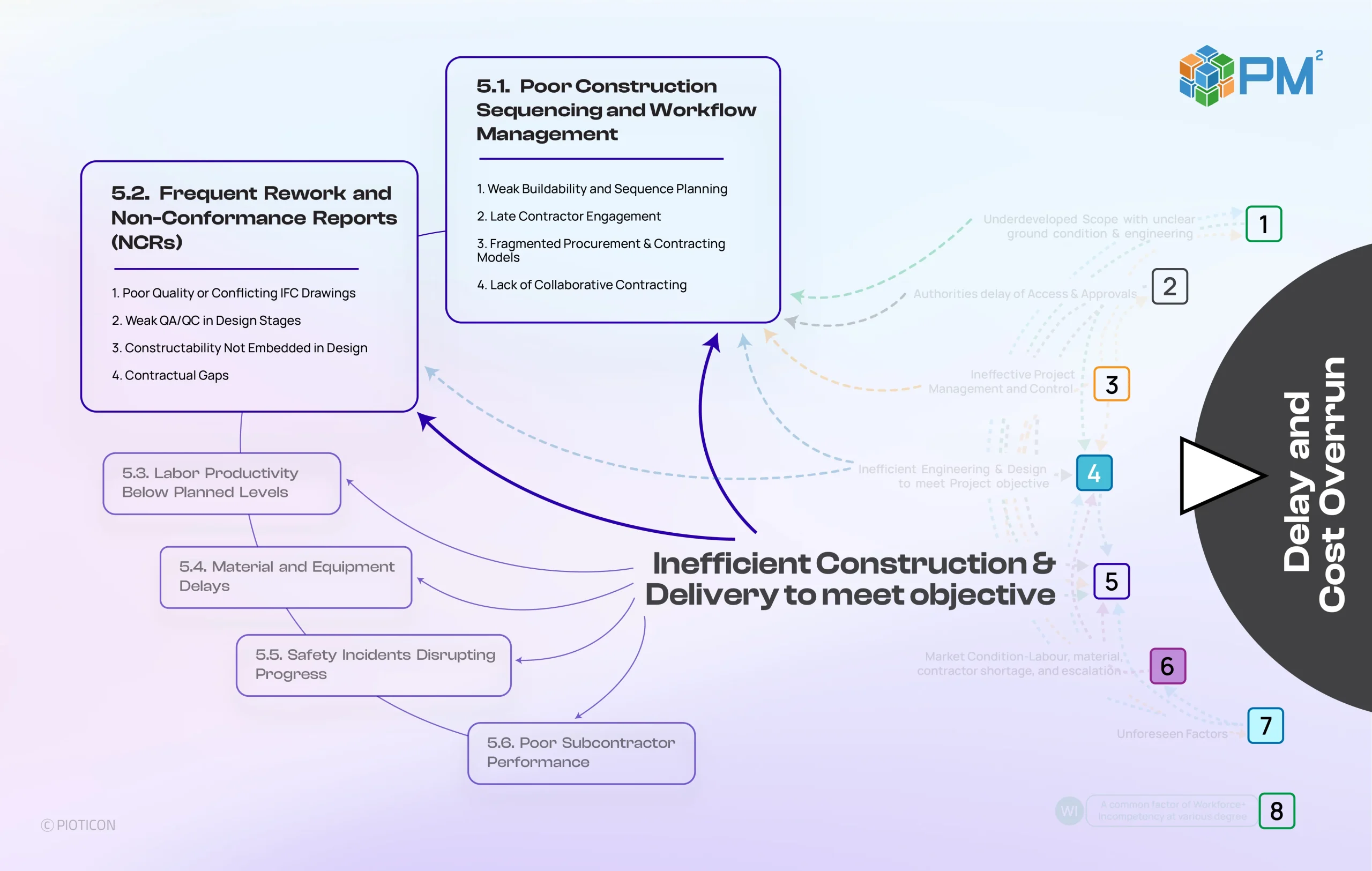
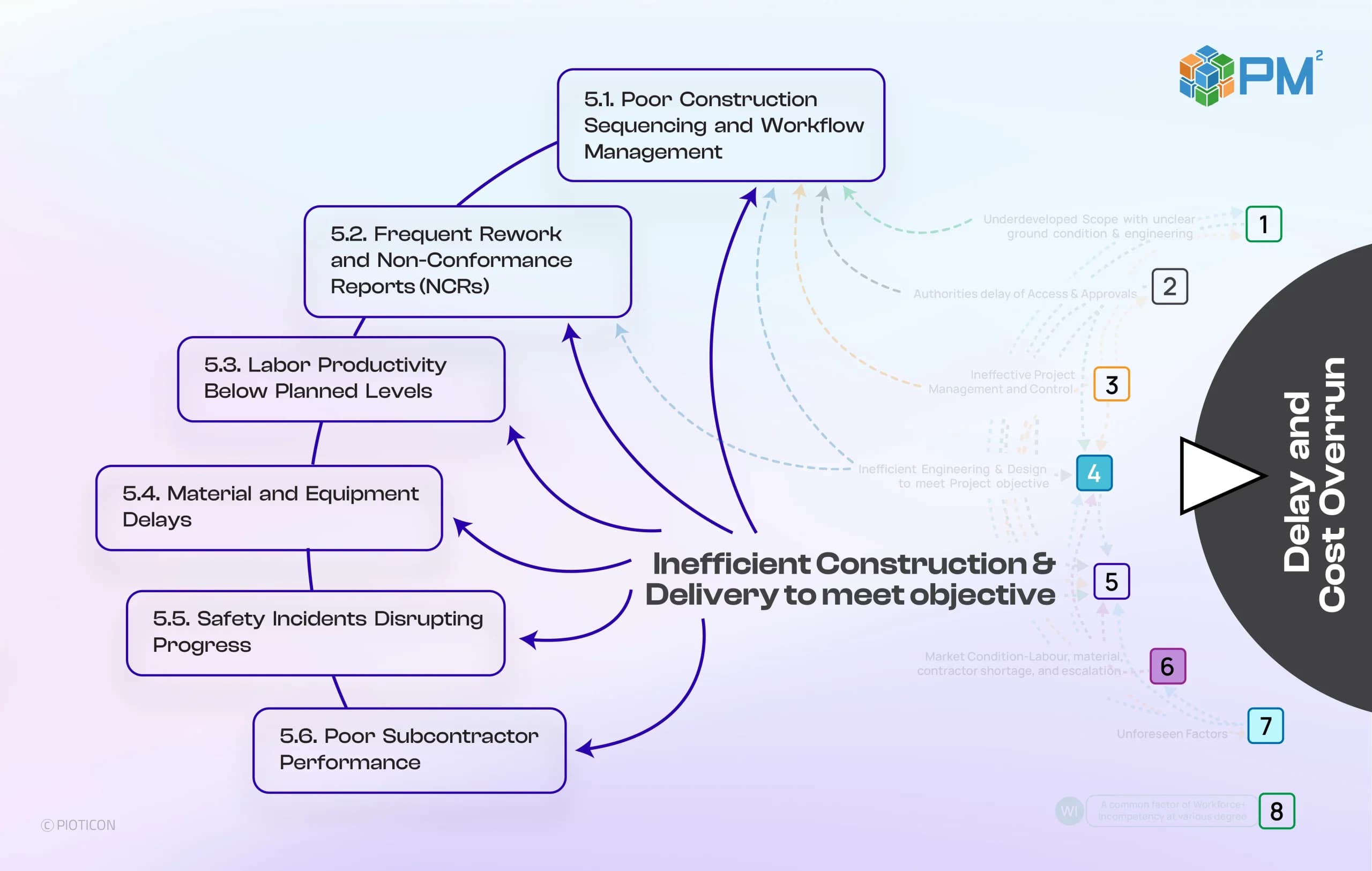
5.1. Poor Construction Sequencing and Workflow Management
The Problem
Projects stall when construction sequences break down, leaving crews idle, rework mounting, and productivity declining.
The Root Causes
1.1 Weak Buildability and Sequence Planning
- Limited use of Expert knowledge and effective technology (4D/5D models) to test constructability
- Engineering deliverables not aligned with field execution logic
- Buildability risks identified late in the cycle
1.2 Late Contractor Engagement
- Contractors brought in after design completion
- Practical field insights missing during sequencing
- Key construction constraints ignored in planning
1.3 Fragmented Procurement & Contracting Models
- Design–Bid–Build reinforces siloed hand-offs
- No framework for early collaboration or integrated solutions
- Lowest-cost tendering suppresses innovation
1.4 Lack of Collaborative Contracting
- Limited use of frameworks like Integrated Project Delivery or Alliancing
- Risk-averse policies discourage alternate sequencing approaches
The Required Shift
- Adopt collaborative procurement frameworks that enable effective early contractor involvement
- Integrate technology into planning and constructability reviews
- Shift bid evaluation toward value creation and buildability, not just cost
5.2. Frequent Rework and Non-Conformance Reports (NCRs)
The Problem
Rework consumes time and money while damaging team morale. Quality lapses repeatedly push projects off track.
The Root Causes
2.1. Poor Quality or Conflicting IFC Drawings
- Drawings lack maturity or contain coordination errors
- Conflicts discovered only during execution
2.2. Weak QA/QC in Design Stages
- Compressed design timelines reduce design review quality
- Early starts push incomplete packages to site
2.3. Constructability Not Embedded in Design
- Field insights not integrated into engineering reviews
- Confusion over who verifies constructability
2.4. Contractual Gaps
- No penalties for design errors discovered on site
- Accountability diffuse across design and build team
The Required Shift
- Institutionalize interdisciplinary constructability reviews with design and field teams
- Enforce design QA/QC gates within project governance
- Tie contractor and designer incentives to quality and constructability KPI
- Use digital common data environments to maintain version control and traceability
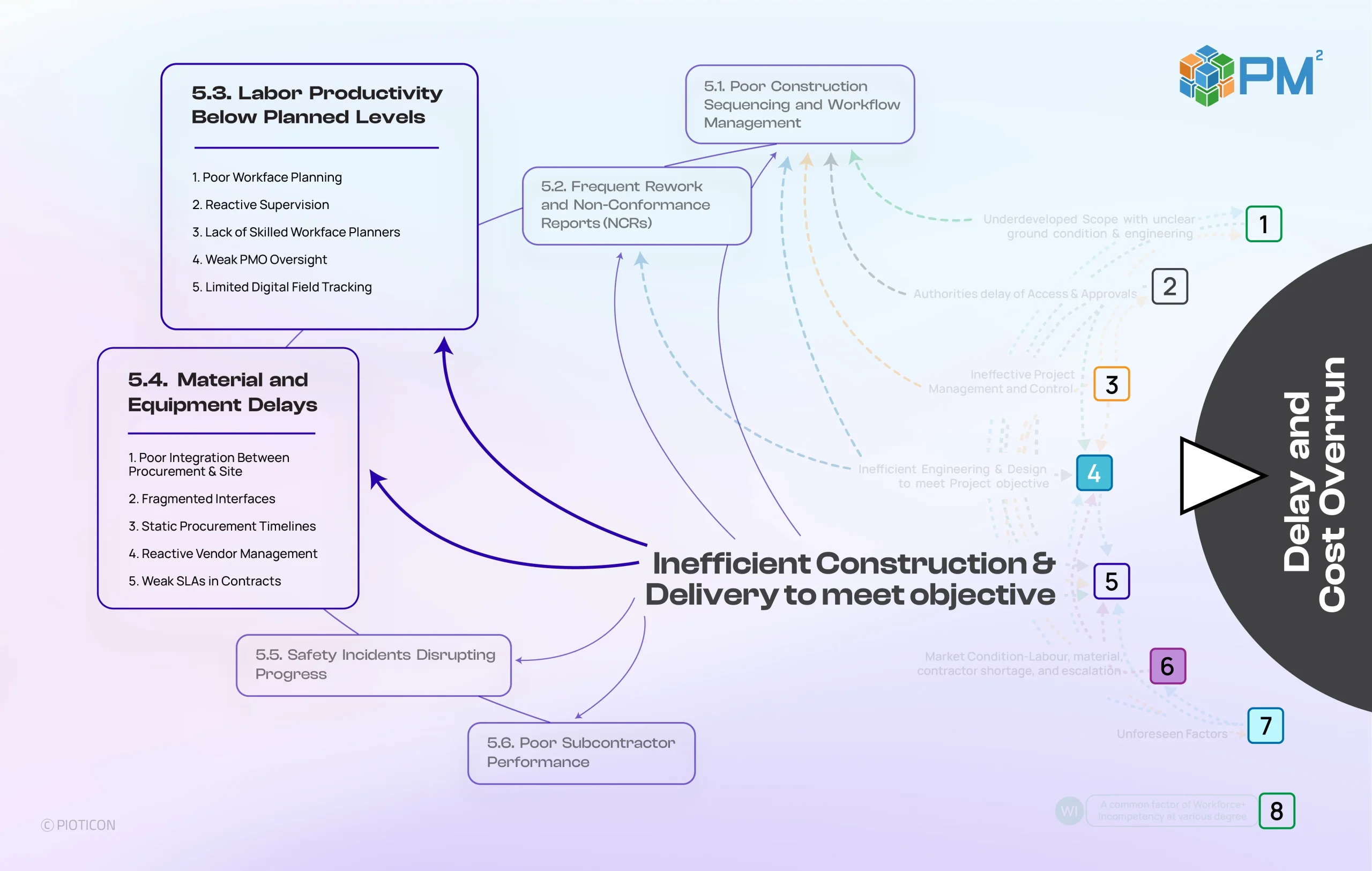
5.3. Labor Productivity Below Planned Levels
The Problem
Workforce productivity often falls below benchmarks, reducing output and straining schedules.
The Root Causes
3.1. Poor Workface Planning
- Crews lack timely access to materials, tools, and work front
- Constraint analyses are irregular or missing
3.2. Reactive Supervision
- Supervisors rely on informal planning
- No standardized work package processes
3.3. Lack of Skilled Workface Planners
- No certification or structured training for workface planning roles
3.4. Weak PMO Oversight
- No governance over work package readiness or performance KPIs
3.5. Limited Digital Field Tracking
- Productivity measured manually with outdated tools
- Real-time issues not escalated quickly
The Required Shift
- Implement Advanced Work Packaging (AWP) governed by a central PMO
- Deploy digital field-execution platforms for real-time productivity tracking
- Establish daily constraint-free work packages and monitor through dashboards
5.4. Material and Equipment Delays
The Problem
Late material and equipment deliveries disrupt work front and force costly resequencing.
The Root Causes
4.1. Poor Integration Between Procurement & Site
- Procurement decisions not synchronized with field progress
- No dynamic planning for material requirements
4.2. Fragmented Interfaces
- Weak coordination between engineering, procurement, and construction
4.3. Static Procurement Timelines
- Plans do not adjust to site progress or design maturity
4.4. Reactive Vendor Management
- Vendor performance tracked only after delays occur
4.5. Weak SLAs in Contracts
- Performance metrics not embedded in procurement agreements
The Required Shift
- Develop integrated supply-chain systems linked to construction schedules
- Use vendor scorecards and dashboards for proactive monitoring
- Embed service-level agreements and reliability metrics in procurement contracts
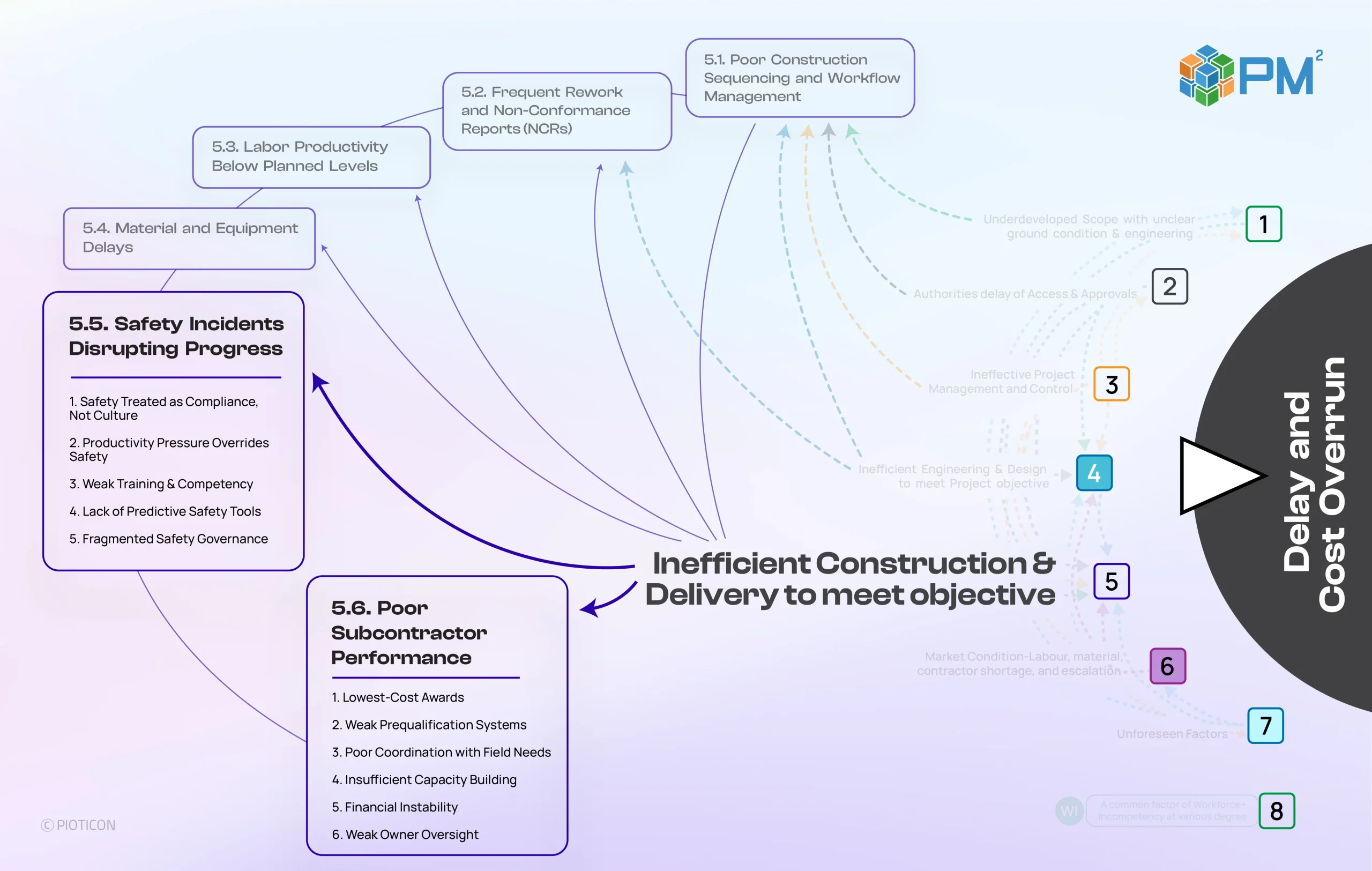
5.5. Safety Incidents or Environmental Hazards Disrupting Progress
The Problem
Safety or Environmental failures not only harm workers and environment but also shut down work fronts and destabilize schedules.
The Root Causes
5.1. Safety Treated as Compliance, Not Culture
- Rules followed superficially without behavioral reinforcement
5.2. Productivity Pressure Overrides Safety
- Supervisors deprioritize safety for speed
5.3. Weak Training & Competency
- Training lacks depth or behavior-based safety components
5.4. Lack of Predictive Safety Tools
- No analytics to anticipate high-risk conditions
5.5. Fragmented Safety Governance
- Roles unclear across owner, contractor, and subcontractor levels
The Required Shift
- Integrate predictive safety analytics into project intelligence systems
- Link contract payments to leading safety indicators
- Build leadership accountability for safety performance at every level
- Elevate safety from rule-following to shared operational culture
5.6. Poor Subcontractor Performance
The Problem
Subcontractors failing to deliver on time, quality, or safety metrics destabilize entire projects.
The Root Causes
6.1. Lowest-Cost Awards
- Capability overlooked for price, reducing reliability
6.2. Weak Prequalification Systems
- No standardized evaluation for capability or history
6.3. Shallow Market for competent Sub-contractors
- Demand for capable sub-contractors exceeds available market supply
6.4. Poor Coordination with Field Needs
- Procurement decisions lack field input
6.5. Insufficient Capacity Building
- No structured training or development for subcontractors
6.6. Financial Instability
- Payment delays and thin margins drive cash-flow stress
6.7. Weak Owner Oversight
- Oversight delegated entirely to main contractors
The Required Shift
- Adopt capability-based subcontractor pre-qualification frameworks
- Build development programs to strengthen local subcontractor capacity
- Maintain owner-level oversight with KPIs for time, quality, and safety
- Introduce performance-linked payments and early-warning reporting
Integrated Solutions Over Isolated Fixes
Construction inefficiency cannot be solved by fixing one part of the system. Improving safety without strengthening planning, or resolving procurement gaps without addressing sequencing, merely transfers the failure.
Each construction sub-cluster both depends on and influences the others:
- Sequencing & Buildability depends on design maturity and procurement readiness.
- Workface Planning & Productivity collapses if materials are late or workfronts are unavailable.
- Quality & Rework Control relies on integrated design–construction communication.
- Material & Equipment Readiness drives or delays productivity and safety.
- Safety Management shapes productivity and workforce stability.
- Subcontractor Capability determines quality, safety, and delivery speed.
- Governance & Intelligence integrates all data for real-time decision-making.
- Workforce Capability underpins every sub-cluster with skilled teams.
| Sub-Clusters | Integrated Solution Focus |
|---|---|
| Sequencing & Buildability | Combine 4D/5D simulation with procurement and site logistics to deliver constructible, conflict-free schedules. |
| Workface Planning & Productivity | Institutionalize Advanced Work Packaging with digital field tracking and PMO oversight. |
| Quality & Rework Control | Establish constructability and QA/QC gates connecting design, field execution, and governance. |
| Material & Equipment Readiness | Link supply-chain dashboards and vendor KPIs with live construction milestones. |
| Safety & Site Risk Management | Apply predictive safety analytics tied to behavioral performance and incentive systems. |
| Subcontractor Capability & Oversight | Use capability-based pre-qualification and performance-linked contracts under owner-level monitoring. |
| Governance & Performance Intelligence | Build unified dashboards combining safety, productivity, and subcontractor data for real-time decision-making. |
| Workforce Capability Development | Create certification and cross-disciplinary training pathways that turn skill into consistent site performance. |
In addition, Construction & Delivery is not self-contained. Its effectiveness is shaped by the other seven clusters of project performance (as defined in Pioticon’s holistic PM² model). For example:
- When Scope keeps changing, baselines collapse and site sequencing breaks down.
- When Access & Approvals slip, workfronts close and productivity drops.
- When Engineering & Design is inefficient, rework multiplies and cost buffers erode.
Construction not only absorbs these shocks but also amplifies them if its own sub-clusters remain fragmented. Integration across all eight clusters is essential for reliable, safe, and cost-effective delivery.
Conclusion: Efficiency Requires Integrated Discipline
Project inefficiency is not caused by individual errors. It arises when systems operate in silos and decisions lack alignment.
Leaders must move beyond isolated fixes. Strengthening safety without improving planning, or optimizing procurement without workforce capability, ensures only partial progress.
Sustainable improvement comes when construction connects with every cluster: scope, approvals, planning, cost, risk, governance, and people, through shared accountability and unified data.
True delivery excellence is not the result of control in one area; it is achieved through coordinated intelligence, disciplined oversight, and synchronized execution.