
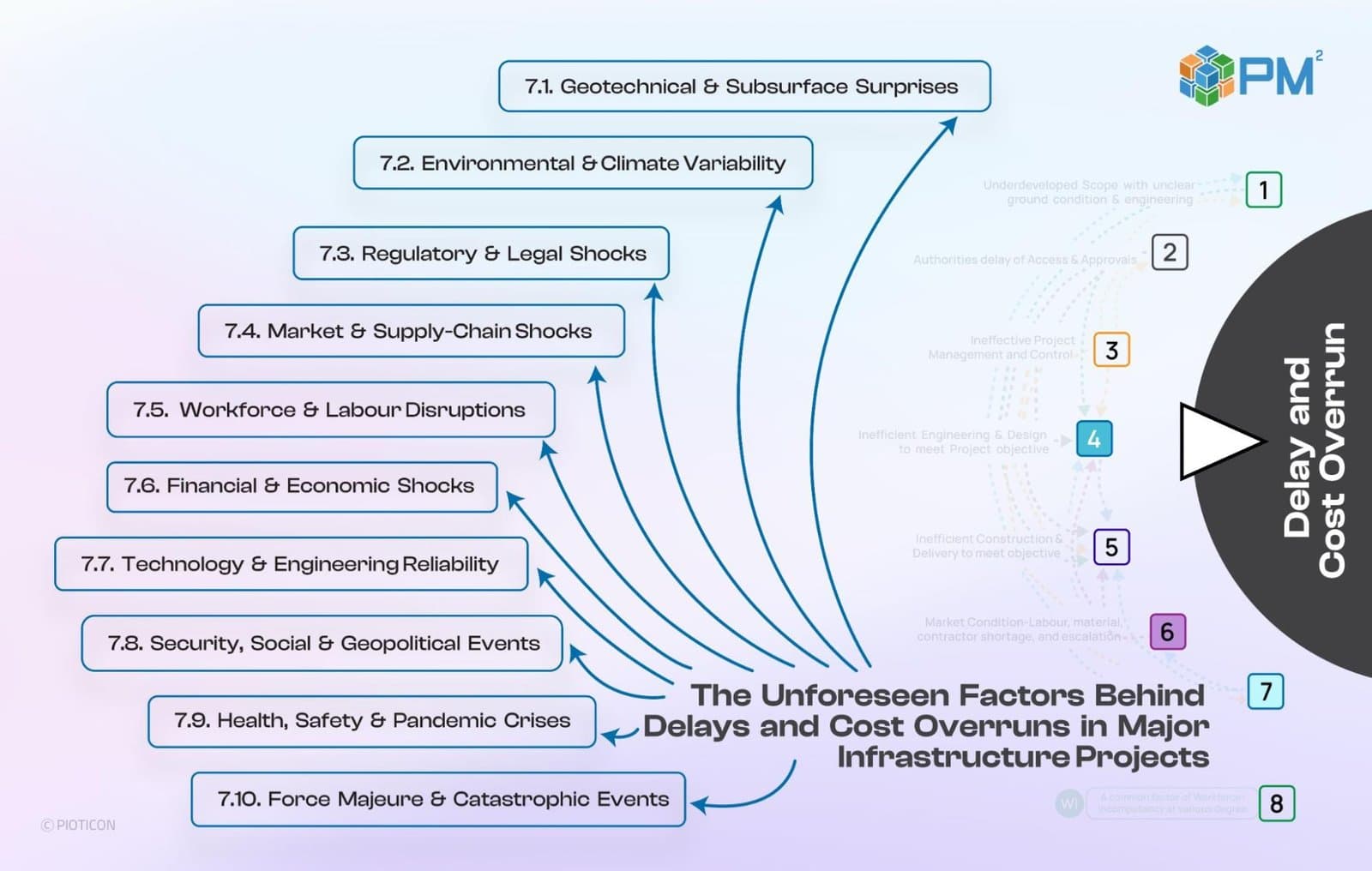
Ambitious mega infrastructure projects are designed to transform economies, connect communities, and enhance national competitiveness. Yet, many of these projects encounter disruptions that push them far off their original baselines. Delays stretch into years, budgets swell beyond contingencies, and teams face challenges they never anticipated at the planning stage.
What derails these projects often isn’t poor intent or lack of planning, but unforeseen factors that strike at critical stages, like unexpected ground conditions, sudden regulatory changes, workforce disruptions, or global market shocks. These events, though unpredictable, follow recognizable patterns that, if understood early, can be managed with foresight and integrated planning.
This article examines the spectrum of unforeseen factors that frequently derail major infrastructure initiatives, explaining why isolated fixes fail and how only integrated solutions can provide real resilience against delay and cost overrun.
The Symptom: Projects Disrupted by the Unpredictable
Even with detailed schedules, risk registers, and budgets, project teams frequently encounter:
- Significant schedule slippages
- Cost overruns beyond approved contingency
- Quality and rework issues from redesigns
- Safety incidents and temporary shutdowns
- Legal disputes, community opposition, or permit withdrawals
These symptoms are visible. The real causes remain buried deeper, across technical, regulatory, social, and financial layers.
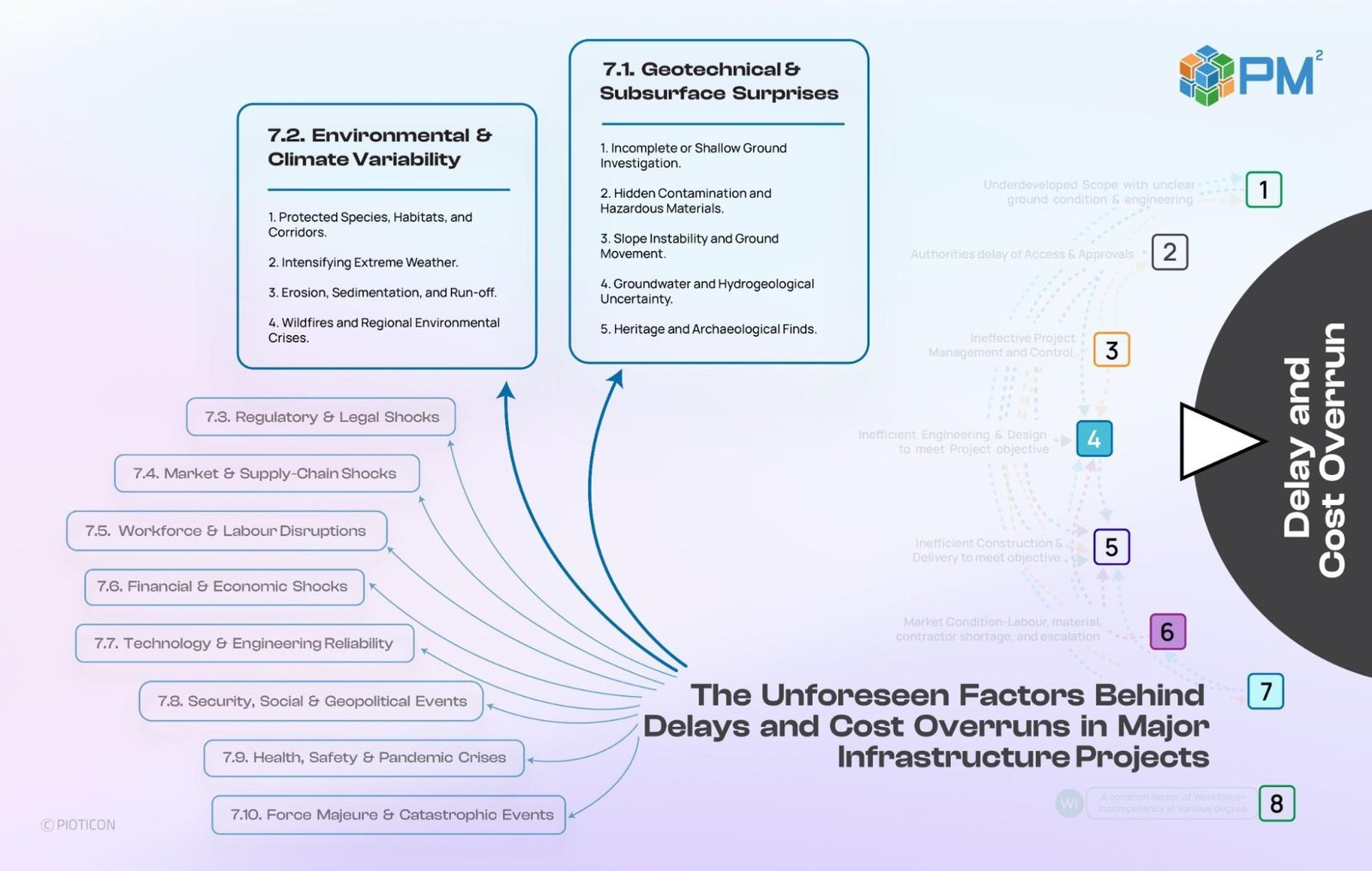
7.1. Geotechnical & Subsurface Surprises
The Problem
One of the earliest and most difficult-to-predict sources of delay lies beneath the surface. Despite advances in site investigation technology, subsurface conditions can still surprise project teams.
The Root Causes
1.1. Incomplete or Shallow Ground Investigation
- Limited boreholes, trial pits, and lab testing fail to capture true ground variability
1.2. Hidden Contamination and Hazardous Materials
- Historic land use and undocumented dumping leave toxic soils undiscovered until work begins
1.3. Slope Instability and Ground Movement
- Marginal slopes or soft ground conditions are underestimated, leading to slips, landslides, or settlements
1.4. Groundwater and Hydrogeological Uncertainty
- High groundwater ingress compromises excavation, stability, and tunnel boring
1.5. Heritage and Archaeological Finds
- Artefacts and protected remains trigger mandatory stoppages and redesign of alignments or structures
The Required Shift
- Run front-end geotechnical maturity reviews with independent peer checks
- Maintain digital ground-risk registers linked to cost and schedule
- Budget for investigative contingencies in high-uncertainty zones
- Engage environment/heritage regulators early to pre-clear sensitive sites
7.2. Environmental & Climate Variability
The Problem
Environmental surprises can disrupt even well-researched projects in ways historical data fails to predict.
The Root Causes
2.1. Protected Species, Habitats, and Corridors
- Undetected or migrating protected species halt work while new assessments and mitigations are prepared
2.2. Intensifying Extreme Weather
- Floods, cloudbursts, storms, heatwaves, and cold snaps exceed design assumptions based on outdated data
2.3. Erosion, Sedimentation, and Run-off
- Insufficient erosion control damages works, creates safety hazards, and attracts regulatory penalties
2.4. Wildfires and Regional Environmental Crises
- Fires damage temporary works, close access roads, or force large-scale evacuations
The Required Shift
- Use dynamic environmental risk modeling tied to construction windows
- Build scenario-based environmental response plans (flood, fire, heat)
- Integrate environmental compliance dashboards into project controls
- Include eco/permits experts in early planning and site selection
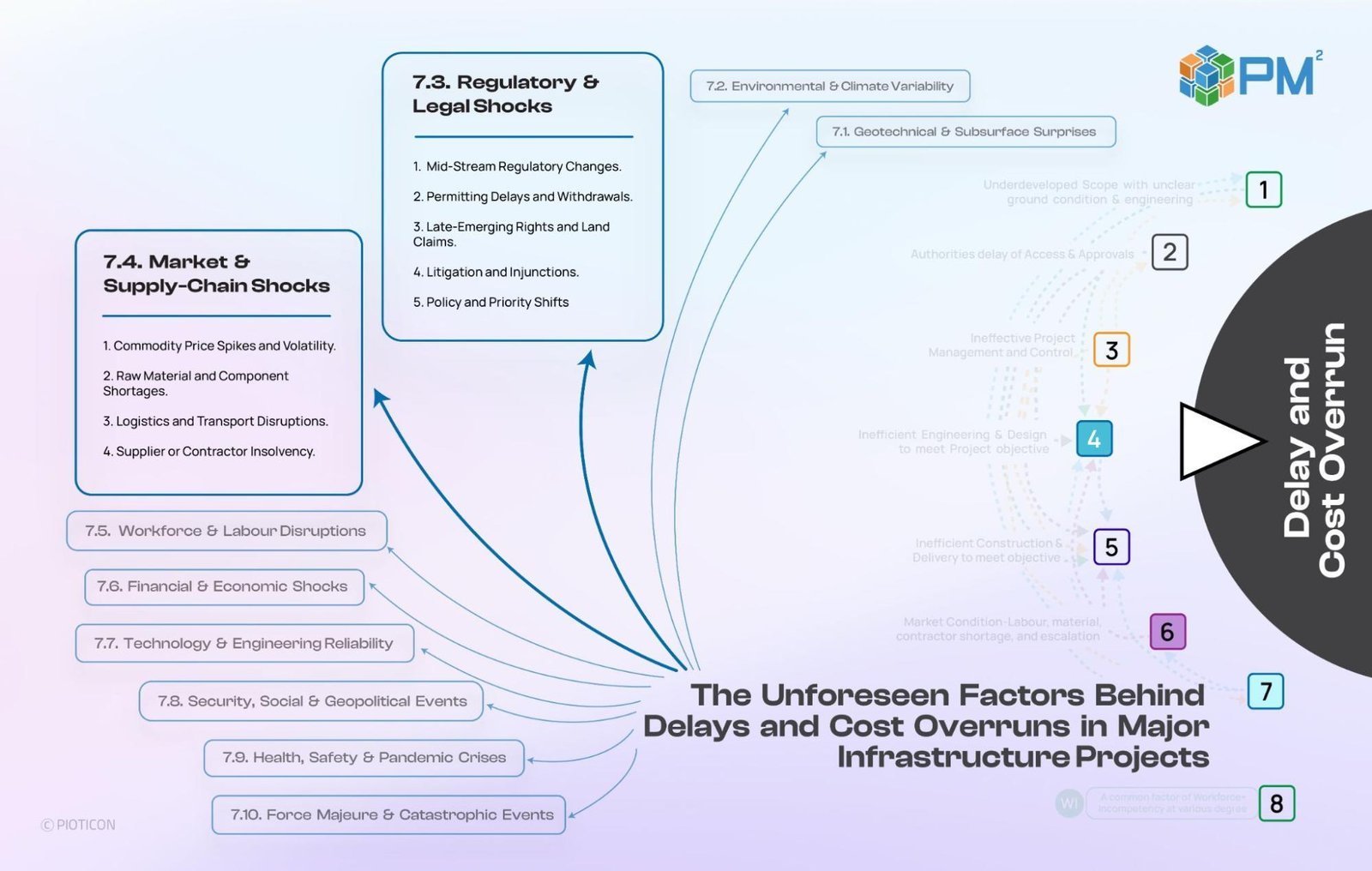
7.3. Regulatory & Legal Shocks
The Problem
The regulatory landscape is not static, and can shift mid-project, derailing momentum.
The Root Causes
3.1. Mid-Stream Regulatory Changes
- New environmental, safety, or labour rules impose retrofit requirements on ongoing works.
3.2. Permitting Delays and Withdrawals
- Approvals are delayed, challenged, or revoked due to administrative issues or political pressure.
3.3. Late-Emerging Rights and Land Claims
- Indigenous or community land rights surface after contracts are awarded, triggering disputes.
3.4. Litigation and Injunctions
- Legal action by activists, competitors, or affected communities leads to court-ordered work stoppages.
3.5. Policy and Priority Shifts
- Government changes re-scope, defer, or cancel projects, as seen in several global rail and energy schemes.
The Required Shift
- Establish continuous regulatory engagement channels
- Use flexible/relational contract models (alliance, target cost) that can absorb change
- Map stakeholders and rights-holders early, not post-award
- Align project governance to monitor policy signals and trigger responses
7.4. Market & Supply-Chain Shocks
The Problem
Global supply chains expose projects to disruptions well beyond local control.
The Root Causes
4.1. Commodity Price Spikes and Volatility
- Steel, cement, copper, fuel, and other inputs surge beyond contingency assumptions
4.2. Raw Material and Component Shortages
- Shortages in mining, manufacturing, or specialized components stall procurement
4.3 Logistics and Transport Disruptions
- Port closures, route blockages, strikes, or pandemics delay key shipments
4.4. Supplier or Contractor Insolvency
- Failure of major suppliers or subcontractors creates sudden capacity gaps and re-procurement delays
The Required Shift
- Build resilient sourcing strategies (dual sources, framework agreements)
- Add commodity risk-sharing / indexation clauses in contracts
- Deploy real-time supply dashboards in project controls
- Prequalify backup suppliers/contractors for critical packages
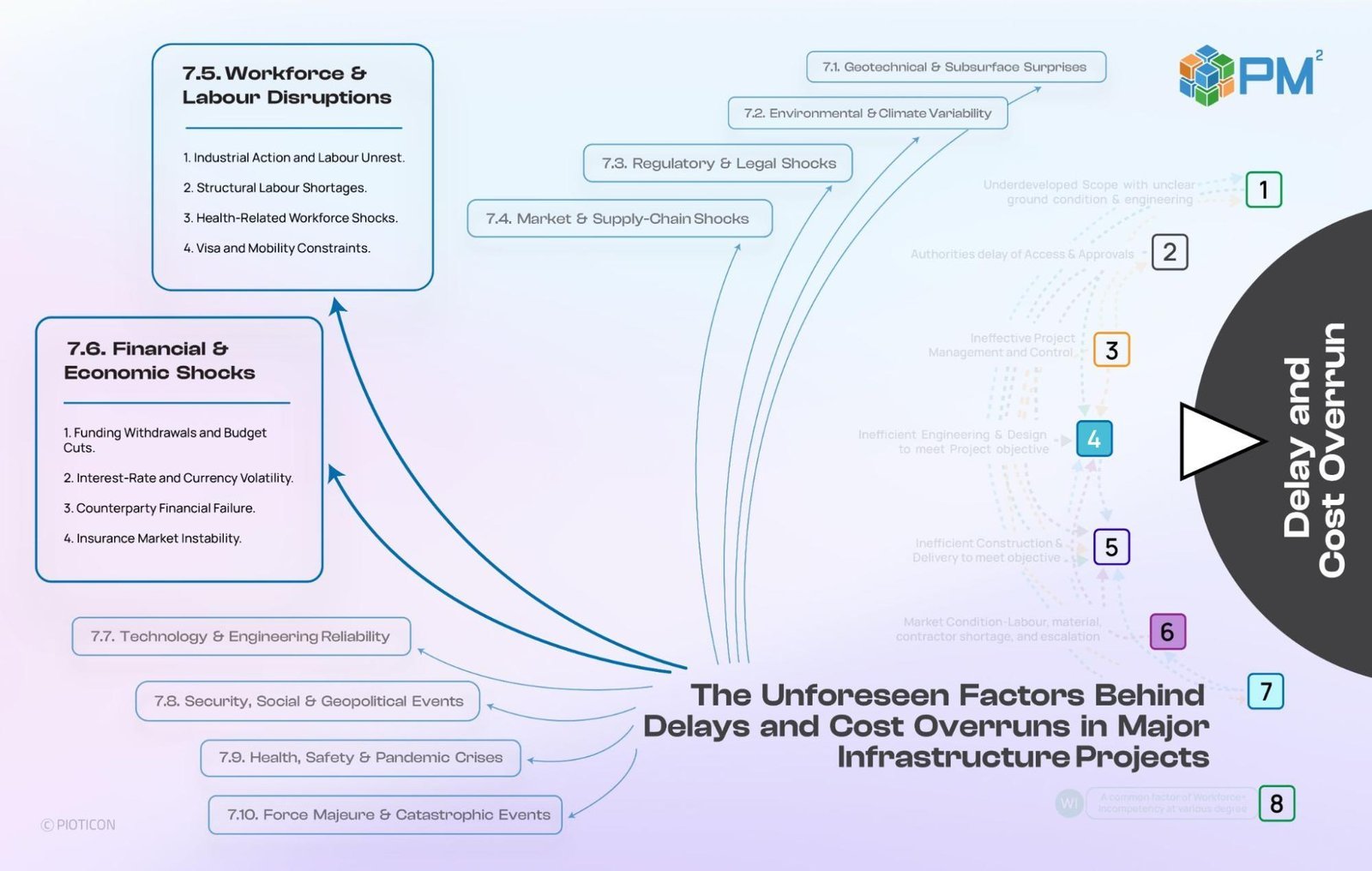
7.5. Workforce & Labour Disruptions
The Problem
Human resources remain one of the most volatile elements of project delivery.
The Root Causes
5.1. Industrial Action and Labour Unrest
- Disputes over pay, conditions, or safety close sites for extended periods
5.2. Structural Labour Shortages
- Demographic change, immigration controls, or competing industries shrink the available pool
5.3. Health-Related Workforce Shocks
- Local outbreaks or pandemics trigger quarantines and site shutdown
5.4. Visa and Mobility Constraints
- Abrupt changes to migration rules or credentials limit access to foreign specialists
The Required Shift
- Create project-level workforce continuity plans (alternates, overtime, redeployment)
- Negotiate early labor/union engagement frameworks
- Enable credential portability across sites/regions
- Embed health and outbreak response protocols in HSE plans
7.6. Financial & Economic Shocks
The Problem
Economic stability is never guaranteed so any financial shocks can derail through project financing and delivery.
The Root Causes
6.1. Funding Withdrawals and Budget Cuts
- Public or private sponsors re-prioritise budgets or withdraw, leaving gaps
6.2. Interest-Rate and Currency Volatility
- Rate hikes and currency devaluations distort long-term financial models
6.3. Counterparty Financial Failure
- Contractors, JV partners, or suppliers go bankrupt mid-project
6.4. Insurance Market Instability
- Insurers reduce coverage, raise premiums, or restrict terms for high-risk assets
The Required Shift
- Use dynamic financial models that reprice as markets move
- Include indexed/escalation clauses in long-duration contracts
- Diversify funding and insurance arrangements
- Monitor counterparty financial health through the project lifecycle
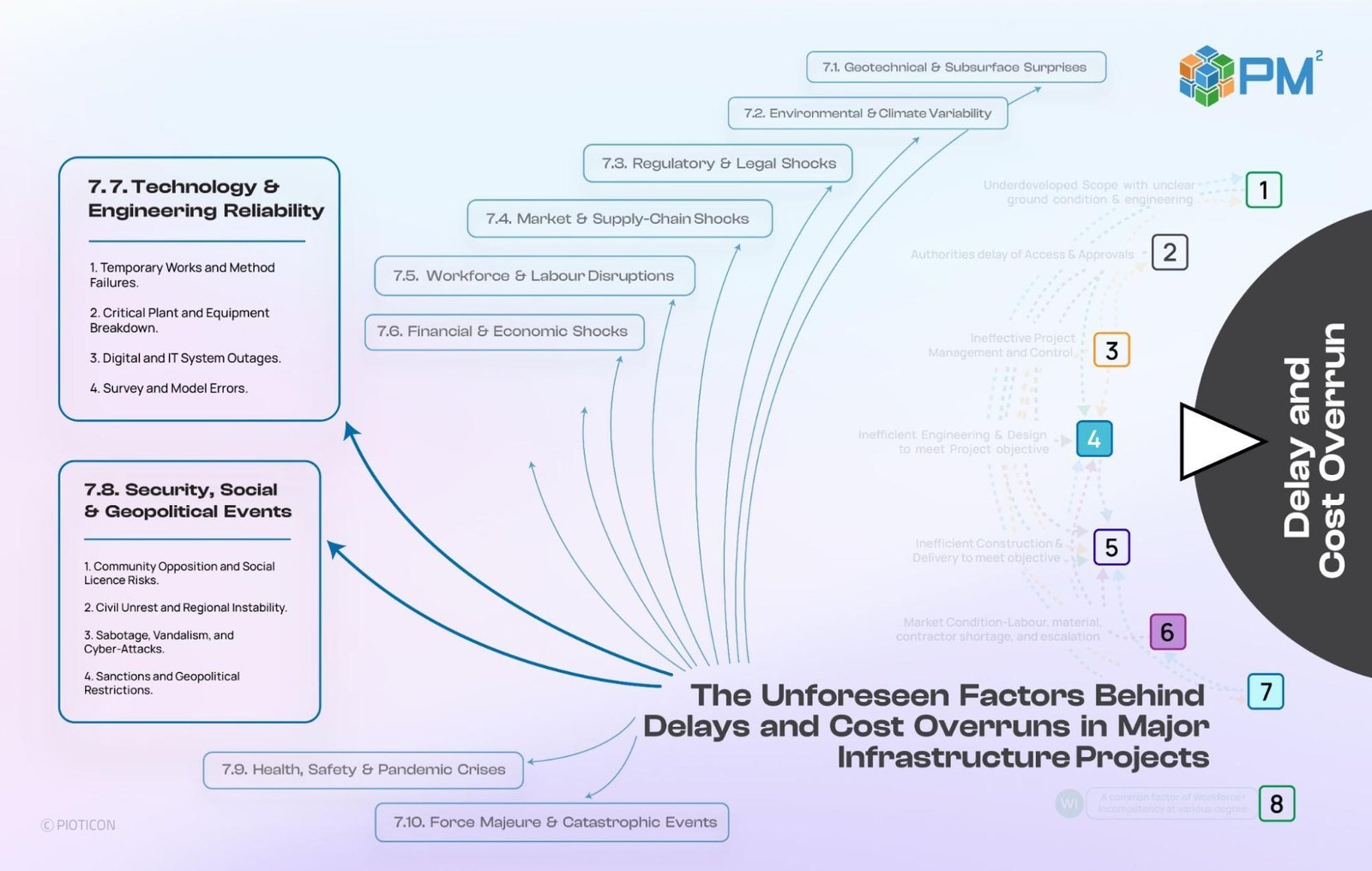
7.7. Technology & Engineering Reliability
Modern infrastructure projects increasingly depend on advanced technologies, which introduces new failure points.
The Root Causes
7.1. Temporary Works and Method Failures
- Inadequate design or execution of temporary works causes failures or collapses.
7.2. Critical Plant and Equipment Breakdown
- TBMs, heavy lifts, or specialist equipment fail with long lead times for repair or replacement
7.3. Digital and IT System Outages
- Failure of project controls, BIM platforms, or communication systems disrupts coordination
7.4. Survey and Model Errors
- Poor survey data or BIM defects propagate into design and construction conflicts
The Required Shift
- Mandate redundancy/contingency for critical plant
- Enforce independent technical/design reviews at key gates
- Run digital quality audits on BIM and survey inputs
- Add IT/OT continuity plans as part of construction readiness
7.8. Security, Social & Geopolitical Events ability
The Problem
Social and political instability presents a persistent external threat to infrastructure continuity.
The Root Causes
8.1. Community Opposition and Social Licence Risks
- Inadequate engagement results in protests, blockades, and reputation damage.
8.2. Civil Unrest and Regional Instability
- Political unrest or conflict endangers personnel and asset
8.3. Sabotage, Vandalism, and Cyber-Attacks
- Physical or digital interference disrupts operations and data integrity.
8.4. Sanctions and Geopolitical Restrictions
- International sanctions affect partners, technology transfer, or supply chains.
The Required Shift
- Implement structured stakeholder and community engagement plans from concept stage
- Integrate security and cyber resilience into project risk registers
- Monitor geopolitical/external affairs as part of project governance
- Create issue-escalation protocols with authorities and communities
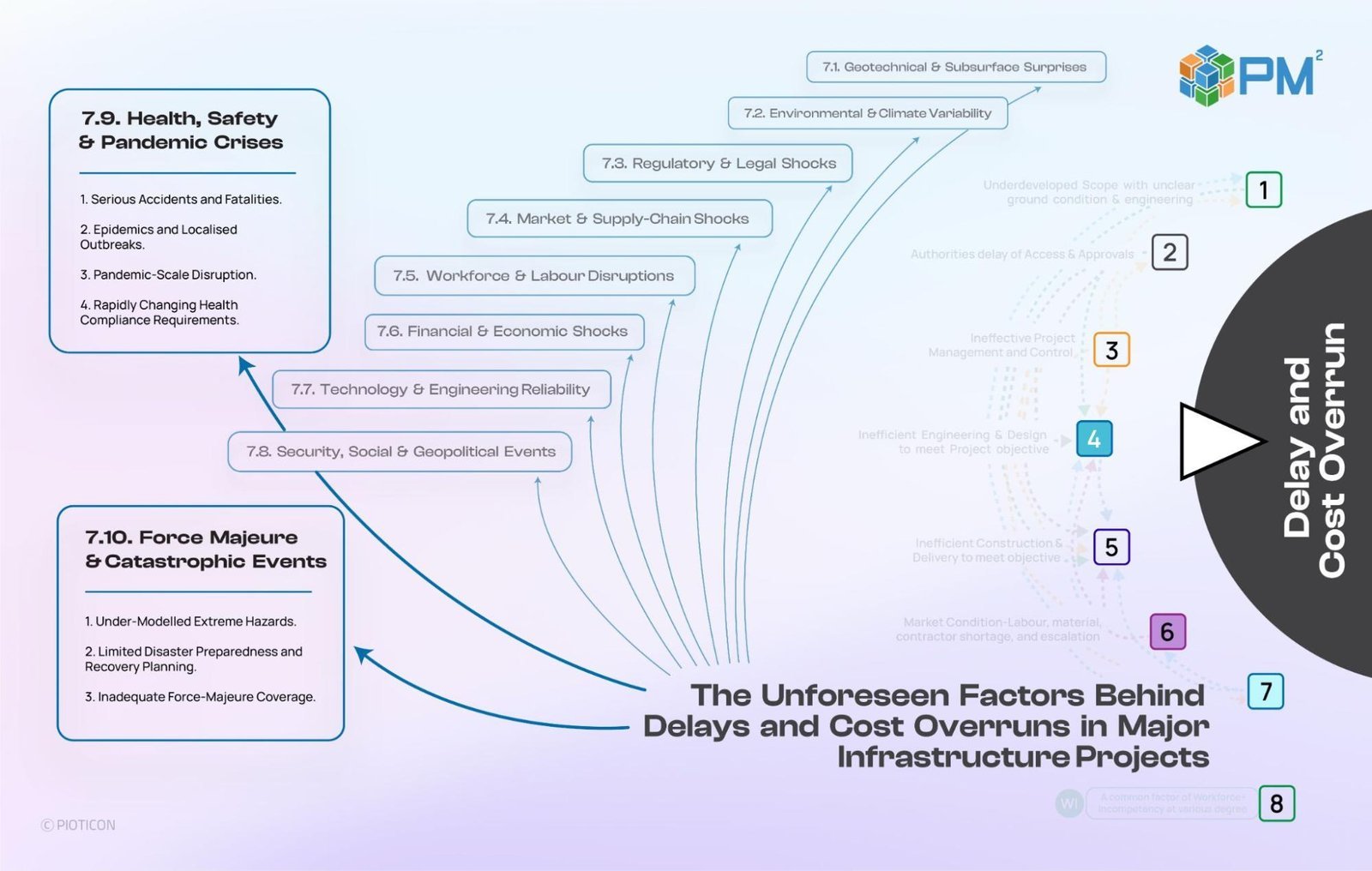
7.9. Health, Safety & Pandemic Crises
The Problem
Health crises not only threaten workforce safety but can also have profound legal and operational impacts.
The Root Causes
9.1. Serious Accidents and Fatalities
- Weak safety culture or oversight results in high-impact incidents
9.2. Epidemics and Localised Outbreaks
- Inadequate health monitoring leads to uncontrolled spread on site
9.3. Pandemic-Scale Disruption
- Global lockdowns disrupt supply chains, travel, and workforce availability
9.4. Rapidly Changing Health Compliance Requirements
- Frequent regulatory updates require costly retrofits and new protocols
The Required Shift
- Use predictive safety analytics and leading indicators
- Tie contract payments/bonuses to HSE performance
- Build pandemic/health response playbooks into site setup
- Accelerate incident investigation and lesson-sharing across packages
7.10. Force Majeure & Catastrophic Events
The Problem
Rare but severe events, like earthquakes, tsunamis, extreme floods, can devastate projects overnight.
The Root Causes
10.1. Under-Modelled Extreme Hazards
- Hazard scenarios beyond standard codes or return periods are not fully analysed
10.2. Limited Disaster Preparedness and Recovery Planning
- Emergency response, remobilisation, and alternate access plans are underdevelope
10.3. Inadequate Force-Majeure Coverage
- Contracts and insurance fail to allocate catastrophic risk clearly or fairly
The Required Shift
- Develop disaster-response and remobilization playbooks
- Negotiate broad force majeure and insurance coverage early
- Run extreme-event simulations at design and planning stages
- Keep strategic emergency resources (plant, materials, access) pre-identified
Integrated Solutions Over Isolated Fixes
Unforeseen events cannot be controlled, but their impact can be shaped. Addressing them piecemeal—geotechnical risk without supply-chain planning, or safety without financial resilience—will never deliver consistent results.
Each unforeseen-event sub-cluster both depends on and influences the others:
- Geotechnical & Subsurface risk must feed into scope, design, contingency, and contract strategy.
- Environmental & Climate variability needs to be integrated with schedule windows, construction methods, and HSE protocols.
- Regulatory & Legal shocks require flexible commercial models and proactive stakeholder engagement.
- Market & Supply-Chain shocks must be managed jointly with Risk, Cost, and Procurement clusters.
- Workforce & Labour disruptions intersect with Market Conditions, HSE, and Governance.
- Financial & Economic shocks interact with all clusters through funding, indexation, and insurance.
- Technology & Engineering reliability connects directly to Design, Construction, and Safety.
- Security, Social & Geopolitical risks demand tight alignment with community, governance, and communications.
- Health, Safety & Pandemic factors must be wired into operations, workforce planning, and commercial terms.
- Force Majeure & Catastrophic events require planning alignment across design, contracts, insurance, and recovery.
| Sub-Cluster | Integrated Solution Focus |
|---|---|
| Geotechnical & Subsurface | Front-end investigation maturity, digital ground-risk registers, and pre-cleared heritage protocols |
| Environmental & Climate Variability | Dynamic environmental modeling integrated with construction windows and compliance dashboards |
| Regulatory & Legal Shocks | Continuous regulator engagement, flexible contracts, and early rights-holder mapping |
| Market & Supply Chain | Dual sourcing, indexation, and real-time supply visibility in project controls |
| Workforce & Labor Disruptions | Mobility frameworks, health protocols, and union/worker early engagement |
| Financial & Economic Shocks | Indexed contracts, flexible funding models, and counterparty health monitoring |
| Technology & Engineering Reliability | Redundancy for critical plant, independent design verification, and digital QA |
| Security, Social & Geopolitical | Structured stakeholder engagement, cyber/security resilience, and escalation pathways |
| Health, Safety & Pandemic | Predictive HSE analytics, pandemic playbooks, and performance-linked contracts |
| Force Majeure & Catastrophic Events | Disaster-recovery and remobilization plans with broad force-majeure and insurance coverage |
In addition, the Unforeseen Events cluster is tightly interwoven with the other seven PM² clusters:
- When Scope & Planning ignore subsurface and climate uncertainty, designs prove brittle under real-world shocks.
- When Market Conditions or Financing are treated separately from risk analytics, contingencies are quickly exhausted.
- When Governance & PMC lack integrated data on external shocks, responses become slow and fragmented.
Unforeseen events do not just hit the project system—they test the quality of integration across all eight clusters.
Conclusion: Integration Is the Only Real Safeguard
Unforeseen events are not rare exceptions in infrastructure delivery; they are recurring realities. Addressing them piecemeal will never deliver consistent success.
Projects that integrate risk identification, flexible commercial models, supply-chain resilience, stakeholder engagement, and crisis-response protocols into one delivery framework are the ones that stay closest to their original promise.
Resilient projects aren’t the ones that avoid surprises, they’re the ones designed to absorb, adapt, and continue.